FAU lands $736,000 from NASA to study the coastal carbon budget from space

FAU harbor branch gulf of Mexico project among 10 grants in the nation and the only university in Florida selected by NASA

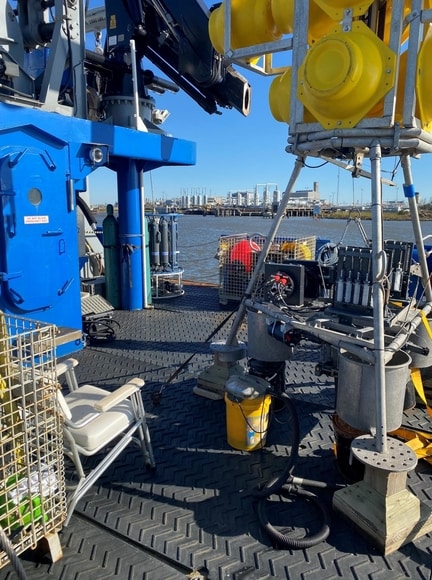
Coastal ecosystems sequester large quantities of carbon through processes at risk of disturbance from changing climate, land-use change, and rising sea levels. How carbon moves from land to ocean is one of the critical knowledge gaps needed to constrain the structure and functioning of the Earth system. In coastal regions, the origin of various carbon sources is very difficult to identify - for example, whether the carbon is from rivers or marsh runoff, or created in place via phytoplankton production. Moreover, the generalization of these sources and the processes involved in transport to the ocean is even more difficult, thus limiting the ability to make future projections based on a changing climate and associated events such as wetter, more intense hurricanes. One of the "benthic landers" that will be used for the project in Gulf of Mexico. The oil refineries in the background are typical of the area researchers will be working on in the Gulf of Mexico's hypoxia region off the coasts of Texas and Louisiana.  CREDIT Jordon Beckler, Florida Atlantic University/Harbor Branch Oceanographic Institute

One potentially underappreciated carbon source, the underlying marine sediments, may be particularly impacted under these conditions and may play an outsized role in the overall carbon budget. Satellite remote sensing is often used as a tool to characterize and quantify the various sources of carbon in coastal regions by measuring colored dissolved organic matter (CDOM) - more colloquially known as the "brown stuff" in rivers in Florida and beyond. However, it is not currently possible to discriminate between sediment-derived carbon versus other sources.

Using satellite images, hydrodynamic modeling, and fieldwork, scientists from Florida Atlantic University's Harbor Branch Oceanographic Institute are setting out to quantify this sediment carbon contribution, make historical reconstructions, and contribute to future projections of the coastal budget. They have received a three-year, $736,000 grant from NASA's Minority University Research and Education Project Ocean Biology and Biogeochemistry (OCEAN). FAU is one of 10 universities in the nation and the only university in Florida to receive this grant in support of NASA's Science Mission Directorate in seeking a better understanding of the ocean's role in the Earth system.

If successful, this research in the Gulf of Mexico's hypoxia region off the coasts of Texas and Louisiana may demonstrate not just the ability, but also the utility, of remote sensing as an observational technique for characterizing potentially critical but often neglected carbon cycle processes related to marine sediments. Marine sediments are essentially a permanent means for carbon removal from the surface of the Earth over geological timescales. Yet, a changing climate, coastal eutrophication (i.e. excess nutrient inputs), and processes such as trawling are reducing their carbon storage capacity, resulting in the "browning" of coastal waters.

The FAU Harbor Branch project targets a NASA objective to "Improve understanding of carbon cycle processes and feedbacks in aquatic critical zones that are particularly vulnerable to environmental changes." Aquatic critical zones are regions where important biogeochemical and physical processes take place and together regulate the functionality of aquatic ecosystems.

The FAU Harbor Branch team includes Veronica Ruiz-Xomchuk, Ph.D., a postdoctoral fellow who will lead the technical research aspects as the scientific principal investigator who has expertise in physical oceanography and ocean modeling; Jordon Beckler, Ph.D., the project's primary principal investigator, and an assistant research professor and a fellow of FAU's Institute for Sensing and Embedded Networks Systems Engineering (I-SENSE) who has expertise in chemical oceanography and sediment geochemistry; and Tim Moore, Ph.D., co-principal investigator and a research professor who has expertise in ocean color and bio-optics.

The team is collaborating with Martial Taillefert, Ph.D., Georgia Tech, who is the chief scientist for a series of National Science Foundation-funded oceanographic research cruises that will be used to explore the effects of ocean acidification on sediment processes. Taillefert has invited the FAU team onboard to leverage this campaign, allowing for the "ground-truthing" of the satellite observations using corresponding measurements obtained directly within the water.

By using a "benthic lander" developed via an existing collaboration between FAU and Georgia Tech to explore blue holes, the team will obtain direct flux measurement of dissolved organic matter and the CDOM from sediments to the water column above the seabed, otherwise known as the benthic-boundary layer. Then, the hydrodynamic model will simulate if, where, and when this carbon may be uplifted to the surface of the ocean where it can potentially be detected using satellite remote sensing.

Researchers will combine these sediment flux measurements with more than 20 years of ocean color satellite data and model ocean current dynamics to simulate this carbon transport, while additionally ensuring to account for other potentially confounding carbon sources such as river inputs. The research team will then extrapolate these sediment measurements across the entire study region over various timescales to corroborate satellite-derived estimates.

"We've seen huge inventories of darkly colored pore water in coastal ocean mud, which we know is CDOM, and I couldn't help but wonder to what extent this carbon could be escaping across the sediment surface and affecting the optical properties of the ocean," said Beckler. "However, it isn't yet possible to directly implicate the sediments over large areas by just looking at satellite images since they aren't able to 'see' more than a few meters below the surface of the ocean. The hydrodynamic model uniquely allows us to bridge the gap between the seafloor and the surface ocean. This is an exciting new avenue for my own sediment-centered research - and a topic that is rather unconventional with regards to NASA's typical project portfolio."

An important aspect of the project is the STEM engagement (science-technology-engineering-mathematics) portion that is weaved throughout the research and involves FAU's PK-12 schools and educational programs. The vast majority of work effort will enhance the capacity for STEM research and educational opportunities for underrepresented groups and will create many opportunities for student/intern engagement regarding ocean issues and experiential learning opportunities and the use of NASA products. The students also are invited to participate in the research cruises, depending on the school year schedule.

"Receiving funding from NASA for this innovative proposal is very exciting because, if we are successful, results from our project will have a tremendous impact on scientific inquiry from space to the seabed," said James Sullivan, Ph.D., executive director, FAU Harbor Branch. "We will know whether or not sediment-derived colored dissolved organic matter is routinely visible in the northern Gulf of Mexico."

FAU is the most racially, culturally, and ethnically diverse university in Florida. In 2016, the FAU College of Engineering and Computer Science received designation as a Hispanic-Serving Institution (HSI) by the United States Department of Education, only awarded to colleges and universities with an enrollment of full-time Hispanic undergraduate students of at least 25 percent. This year, FAU's College of Engineering and Computer Science was recognized as a national leader in diversity in engineering by the American Society of Engineering Education.

eROSITA magneticum simulations show how the matter highway in space makes galaxy clusters grow

Six months ago, astronomers at the University of Bonn reported the discovery of an extremely long intergalactic gas filament with the X-ray telescope eROSITA. A new study has now focused on an interesting structure in the filament, the northern clump. Their new observational data prove that this is a cluster of galaxies with a black hole at its center. Therefore, the gas filament is a galactic matter highway: The northern clump is moving along it towards two more giant galaxy clusters and will eventually merge with them. The paper will be published in the journal Astronomy & Astrophysics, along with other papers published on the occasion of the first eROSITA data release.

The universe resembles a Swiss cheese - but one with huge holes: Large areas in space are absolutely empty. In between, thousands of galaxies crowd in a comparatively small space. These clusters are connected by highways of thin matter gas, like the gossamer filaments of a spider's web. The northern clump - as it appears in X-rays (blue, XMM-Newton satellite), in visual light (green, DECam), and at radio wavelengths (red, ASKAP/EMU).

At least, this is what the standard model of cosmology predicts. Whether this is actually the case was hard to prove until recently. This is because the matter in the gas filaments is so diluted that it eluded the view of even the most sensitive measuring instruments: The filaments contain just ten particles per cubic meter, which is far fewer than are present in the best vacuum that humans can produce.

This is why a study led by the University of Bonn in Germany caused such a stir last winter. The researchers had discovered an intergalactic gas filament measuring at least 50 million light-years in length that emanates from two giant galaxy clusters. "There is another galaxy cluster in this filament, the northern clump," explains Prof. Dr. Thomas Reiprich of the Argelander Institute for Astronomy at the University of Bonn. "In the paper now submitted for publication, we have taken a closer look at this."

Bow shock and matter tail

To do this, the researchers combined images from several sources: the SRG/eROSITA, XMM-Newton, and Chandra satellites, as well as the EMU survey with the ASKAP radio telescope and DECam optical data. The resulting images have a richness of detail never seen before. "This allows us to identify a large galaxy at the center of the northern clump," says Reiprich's colleague and lead author of the study, Angie Veronica. "And at its center sits a supermassive black hole." Two so-called matter jets emanate from it, in which the particles move away from the black hole at close to the speed of light. This produces synchrotron radiation, which can be visualized in radio telescope images.

In addition, the northern clump contains very hot matter gas. "Because of its high temperature of 20 million degrees, it emits X-rays, which we see in the eROSITA images and have now been able to measure very precisely with the XMM-Newton satellite," says Veronica. Overall, the combination of data sources indicates that the northern clump is likely moving at high velocity. The jets of matter emanating from the black hole point backward like the braids of a running girl; in front of the clump, the gas additionally seems to form a kind of bow shock. "We also see a matter tail behind it," Reiprich explains. "We currently interpret this observation to mean that the northern clump is losing matter as it travels. However, it could also be the case that even smaller clumps of matter in the highway are falling towards the northern clump."

Overall, the observations confirm the view derived from theories that the gas filament is an intergalactic matter highway. The northern clump is moving along this road at high speed toward two other much larger clusters of galaxies called Abell 3391 and Abell 3395. "It falls on these piles, so to speak, and will continue to make them bigger - according to the principle: Whoever has will be given more," explains Reiprich, who is also a member of the transdisciplinary research area "Building Blocks of Matter" at the University of Bonn. "What we're seeing is a snapshot of this fall."

Observations consistent with theoretical predictions

The observations are remarkably consistent with the result of the Magneticum supercomputer simulations developed by researchers of the eROSITA consortium. Therefore, they can also be taken as an argument that the current assumptions about the origin and evolution of the universe are correct. This includes the thesis that a large part of the matter is invisible to our measuring instruments. 85 percent of the matter in our universe is said to consist of this "dark matter". One of its most important roles in the standard model of cosmology is as a condensation nucleus, which caused gaseous matter to condense into galaxies after the Big Bang.

RAMBO speeds searches on massive DNA databases

Rice method cuts indexing times from weeks to hours, search times from hours to minutes

Rice University computer scientists are sending RAMBO to rescue genomic researchers who sometimes wait days or weeks for search results from enormous DNA databases.

DNA sequencing is so popular, genomic datasets are doubling in size every two years, and the tools to search the data haven't kept pace. Researchers who compare DNA across genomes or study the evolution of organisms like the virus that causes COVID-19 often wait weeks for software to index large, "metagenomic" databases, which get bigger every month and are now measured in petabytes.

RAMBO, which is short for "repeated and merged bloom filter," is a new method that can cut indexing times for such databases from weeks to hours and search times from hours to seconds. Gaurav Gupta is a Ph.D. student in electrical and computer engineering at Rice University.

"Querying millions of DNA sequences against a large database with traditional approaches can take several hours on a large compute cluster and can take several weeks on a single server," said RAMBO co-creator Todd Treangen, a Rice computer scientist whose lab specializes in metagenomics. "Reducing database indexing times, in addition to query times, is crucially important as the size of genomic databases are continuing to grow at an incredible pace."

To solve the problem, Treangen teamed with Rice computer scientist Anshumali Shrivastava, who specializes in creating algorithms that make big data and machine learning faster and more scalable, and graduate students Gaurav Gupta and Minghao Yan, co-lead authors.

RAMBO uses a data structure that has a significantly faster query time than state-of-the-art genome indexing methods as well as other advantages like ease of parallelization, a zero false-negative rate, and a low false-positive rate.

"The search time of RAMBO is up to 35 times faster than existing methods," said Gupta, a doctoral student in electrical and computer engineering. In experiments using a 170-terabyte dataset of microbial genomes, Gupta said RAMBO reduced indexing times from "six weeks on a sophisticated, dedicated cluster to nine hours on a shared commodity cluster."

Yan, a master's student in computer science, said, "On this huge archive, RAMBO can search for a gene sequence in a couple of milliseconds, even sub-milliseconds using a standard server of 100 machines." Minghao Yan is a Ph.D. student in computer science at Rice University.

RAMBO improves on the performance of Bloom filters, a half-century-old search technique that has been applied to genomic sequence search in several previous studies. RAMBO improves on earlier Bloom filter methods for genomic search by employing a probabilistic data structure known as a count-min sketch that "leads to a better query time and memory trade-off" than earlier methods, and "beats the current baselines by achieving a very robust, low-memory and ultrafast indexing data structure," the authors wrote in the study.

Gupta and Yan said RAMBO has the potential to democratize genomic search by making it possible for almost any lab to quickly and inexpensively search huge genomic archives with off-the-shelf computers.

"RAMBO could decrease the wait time for tons of investigations in bioinformatics, such as searching for the presence of SARS-CoV-2 in wastewater metagenomes across the globe," Yan said. "RAMBO could become instrumental in the study of cancer genomics and bacterial genome evolution, for example."