

American, Japanese team's folding simulations solve a puzzle to design larger proteins

A team from Japan and the United States has identified the design principles for creating large "ideal" proteins from scratch, paving the way for the design of proteins with new biochemical functions.

The team had previously developed principles to design small versions of what they call "ideal proteins," which are structures without internal energetic frustration.

Such proteins are typically designed with a molecular feature called beta strands, which serve a key structural role for the molecules. In previous designs, the researchers successfully designed alpha-beta proteins with four beta-strands.

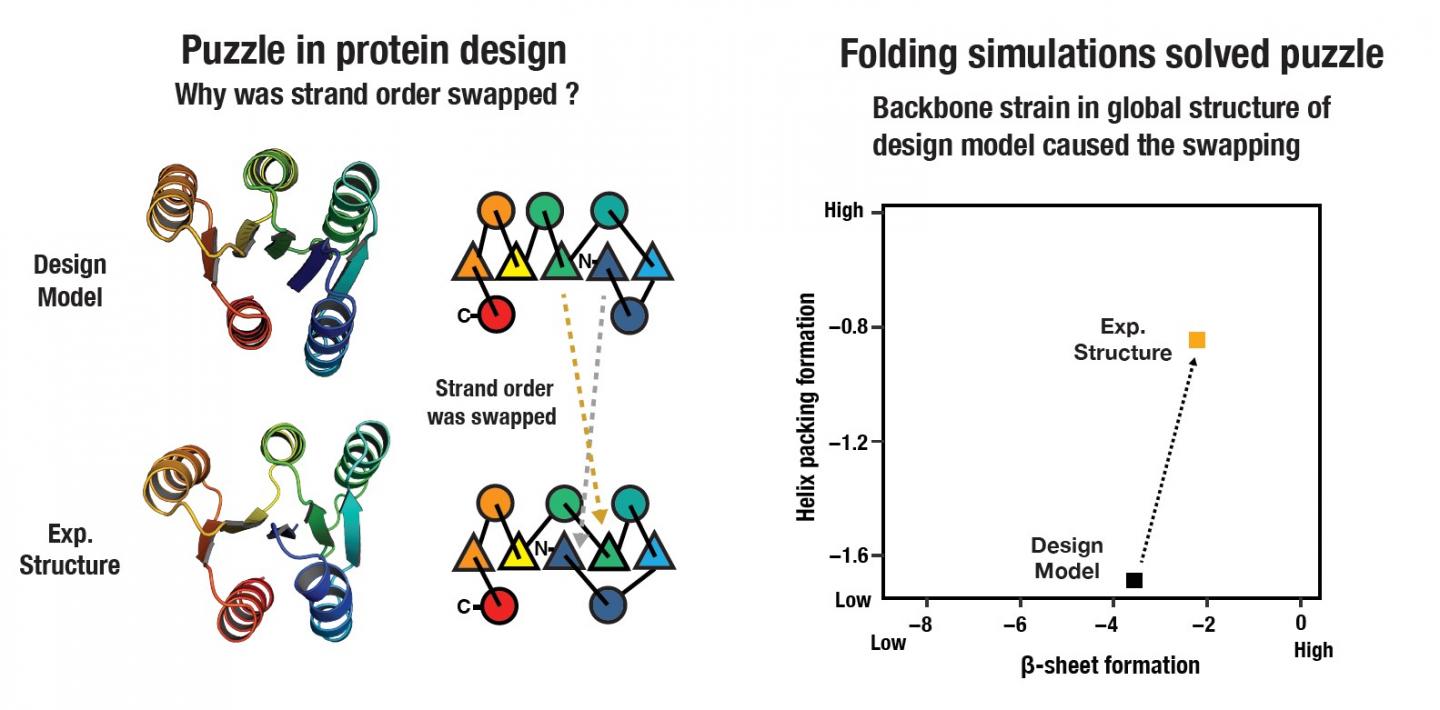
"The ideal proteins we have created so far are much more stable and more soluble than proteins commonly found in nature. We think these proteins will become useful starting points for designing new biochemical functions of interest," said co-first author Rie Koga, a researcher in Exploratory Research Center of Life and Living Systems of Japan's National Institutes of Natural Sciences (NINS). (left) The strand order swapping in de novo design of larger alpha-beta proteins has been a long-standing problem for the research team. (right) Backbone ensembles generated from folding simulations identified that backbone strain caused the strand swapping.
The team found that while the designed proteins were structurally ideal, they are too small to harbor functional sites.
"We set out to test the generality of the design principles we developed previously by applying them to the design of larger alpha-beta proteins with five and six beta-strands," said co-first author Nobuyasu Koga, associate professor in the Institute for Molecular Science of NINS.

The results were puzzling. They found that their experimental structures differed from their supercomputer models, resulting in proteins that folded differently by swapping the internal locations of their beta-strands. The team struggled with the strand swapping puzzle, but by iterating between computational design and laboratory experiments, they concluded.

"We emphasize that experimental structure determination is important for iterative improvement of computational protein design," said co-first author Gaohua Liu, chief scientific officer of Nexomics Biosciences.

"Sometimes we learn the most from these ideal proteins when their experimental structures differ, rather than match, their intended design, since this can lead to a deeper understanding of the underlying principles", added Gaetano Montelione, co-author and professor of chemistry and chemical biology at Rensselaer Polytechnic Institute.

The reason for the strand swapping, they determined, was due to the strain of the whole system on the foundational backbone structure. According to Nobuyasu Koga, the strain is global, instead of connection to connection. Proteins can adjust the length and register of strands across the system to alleviate this backbone strain.

Next, the researchers plan to continue studying the trade-off between more functional proteins with what could be considered less-than-ideal qualities.

"We would like to design proteins with more complex functional sites by incorporating non-ideal features such as longer loops, which are important not only for function but also for relieving global backbone strain," said David Baker, co-author, and professor of biochemistry at the University of Washington.

Physicist Jean Dalibard awarded the 2021 CNRS Gold Medal

The CNRS Gold Medal was created in 1945 as one of the most prestigious French scientific awards. This year it will distinguish the physicist Jean Dalibard for his pioneering research in the physics of ultracold quantum matter. He has made major contributions to the emergence of quantum technologies, which are based on a deep understanding of the quantum properties of matter and how to control them. After a 30-year career at the CNRS, he is now a professor at the Collège de France. He will be awarded the CNRS gold medal on December 8, 2021 during a ceremony in Paris. © Frédérique PLAS/LKB/CNRS Photothèque

Jean Dalibard, who was born in 1958 and joined the CNRS in 1982, is a specialist in quantum physics. A member of the French Academy of Sciences since 2004, he has been a professor at the Collège de France since 2012. As part of the Kastler Brossel Laboratory (CNRS/ENS-PSL/Sorbonne Université/Collège de France), he has pursued a unique career as an experimentalist and theorist, and served as a guest researcher at the National Institute for Standards and Technology (United States) and the Cavendish Laboratory at Cambridge University (United Kingdom), in addition to teaching at numerous foreign universities.

For CNRS President & CEO Antoine Petit, "Jean Dalibard's research has contributed to the emergence of quantum technologies by developing sources for atoms cooled and trapped by light, and by proposing quantum simulators that use these ultracold atomic gases to solve complex problems in other areas of physics. It is his remarkable career as a researcher and instructor that the CNRS is recognizing by awarding the 2021 Gold Medal to Jean Dalibard, who worked for 30 years at the CNRS before joining the Collège de France. The international renown of this specialist in cold atoms bears witness to the strength and influence of the French school of physics."

Dalibard's research is at the heart of atomic physics and radiation. He is internationally recognized as a leader in the field of quantum gases, especially Bose-Einstein condensates, a particular state of matter at very low temperatures. He studies the properties of assemblies of atoms slowed and even stopped by lasers. Once immobilized, these atoms can be trapped in controllable spatial configurations, with a view to fundamental explorations or applications.

He has made major contributions to the emergence of quantum technology, which is based on the understanding and control of the quantum properties of matter. We notably owe him the principle of the magneto-optical trap, a tool that confines atoms while cooling them. It has become essential for certain experiments on cold atoms conducted every day by many laboratories across the globe.

With his team, Jean Dalibard also developed the Monte Carlo wave-function theoretical method, also known as quantum trajectories, which is used by many scientists to simulate the behavior of atom and photon systems in various experimental situations. The first experiments he conducted on quantized vortices in cold atom gases opened the way for the highly active research field focusing on the superfluidity of these systems. These vortices demonstrate very general behaviors of matter and make it possible to test, with adjustable and controlled parameters, concepts from condensed matter physics.

Finally, he is working on quantum simulation, an approach that can experimentally solve problems beyond the reach of today's supercomputing power through the use of cold atom gases. These offer a promising platform for preparing and studying complex quantum systems is perfectly controlled conditions, as well as for answering questions from solid-state physics, nuclear physics, and astrophysics.

During his career, Dalibard has proven to be a brilliant teacher with exceptional pedagogical talents. The holder of an agrégation in physics, he has taught throughout his career, first at the master's level at l'École normale supérieure, and then as a professor at l'École Polytechnique. He organized and taught series of courses for his colleagues at the École des Houches and the École de Cargèse. Highly involved in French research life, he has completed many assignments for the scientific community as a member of numerous scientific boards and the editorial committees of prestigious international scientific journals (Physical Review Letters, Physical Review A, Reviews of Modern Physics).

Kavli IPMU's Murayama proves that QCD can create light-weight subatomic particles

Using only a pen and paper, a theoretical physicist has proved a decades-old claim that a strong force called Quantum Chromo Dynamics (QCD) leads to light-weight pions, reports a new study published on June 23 in Physical Review Letters.

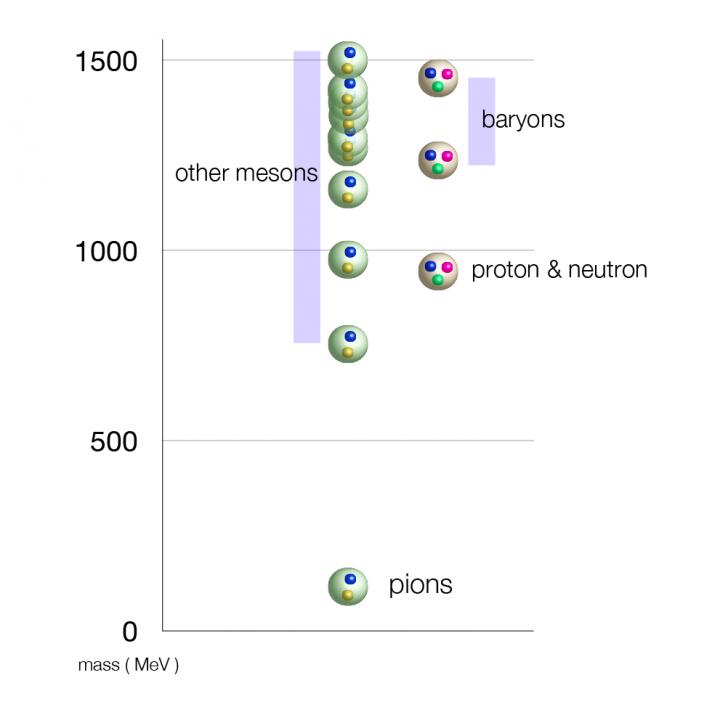
The strong force is responsible for many things in our Universe, from making the Sunshine, to keeping quarks inside protons. This is important because it makes sure that the protons and neutrons bind to form nuclei of every atom that exists. But there is still a lot of mystery surrounding the strong force. Einstein's relation E=mc2 means a strong force leads to more energy, and more energy means a heavier mass. But subatomic particles called pions are very lightweight. Otherwise, nuclei would not bind, there would be no atoms other than hydrogen, and we wouldn't exist.

Why? Compared with the mass spectrum of mesons on the left side, and protons, neutrons and baryons on the right side, it is clear pions are very light-weight.

When quarks were discovered experimentally by striking them out of a proton with energetic electrons, scientists came up with the "explanation" that a property of the strong force called confinement was imprisoning quarks, preventing them from being observed directly. However, the mystery remained that no one could give theoretical proof that derived confinement from QCD.

Late Nobel Laureate Yoichiro Nambu proposed a concept called "spontaneous symmetry breaking" which was responsible for creating essentially massless particles equivalent to pions. That is why these pions are so light in weight (in the real world, the small intrinsic mass of quarks does not create completely massless particles). But yet again, no one could demonstrate that the theory of the strong force, QCD, realizes the proposed spontaneous symmetry breaking. The left side shows if pions were heavy, they would not be able to mediate a strong force between two protons, and as a result the protons would move away from one another. The right side shows how light-weight pions in the real world are able to bind two protons together by mediating a strong force between them. In other words, if pions were not light-weight, protons and neutrons would not be able to bind together to form nuclei, and the only atoms in the Universe would be single proton hydrogen atoms.

So Kavli Institute for the Physics and Mathematics of the Universe (Kavli IPMU) Principal Investigator Hitoshi Murayama solved this problem using a version of the theory with a mathematically elegant enhancement called supersymmetry. Yet the real world does not have supersymmetry. Murayama approached the real world using a specific way of breaking supersymmetry called anomaly mediation that he proposed back in 1998.

In doing so, Murayama managed to show that QCD indeed leads to very light-weight pions, something that had been suggested by numerical simulations with supercomputers, but technically impossible with massless quarks to definitively answer the question.

"I always hoped to understand how the strong nuclear force works so that we can exist. I'm very excited that I managed to prove Nambu's theory from QCD that has been so difficult for decades. This is a part of my long quest for why we exist. Physics may not be too far away from answering this millennia-long question," said Murayama. A summary of this study. (Leftmost column) In 1994, Nathan Seiberg and Edward Witten proposed a model with extended supersymmetry to show confinement was a consequence of Quantum Chromo Dynamics (QCD). (Rightmost column) In 1961, Yoichiro Nambu proposed a concept of QCD called the chiral symmetry breaking, which provided a real world representation of the strong force. (Centre column) In 2021, Hitoshi Murayama used anomaly mediation, which he and collaborators proposed in 1998, to break supersymmetry, allowing him to connect the Seiberg and Witten model to the real world that Nambu had proposed. As a result, Murayama was able to find theoretical proof of Nambu's prediction that pions are light because chiral symmetry breaking occurs in QCD.

The study may open up new avenues to the study dynamics of non-supersymmetric gauge theories.