

It takes a tremendous amount of supercomputer simulations to create a device like an MRI scanner that can image your brain by detecting electromagnetic waves propagating through tissue. The tricky part is figuring out how electromagnetic waves will react when they come in contact with the materials in the device.
SMU researchers have developed an algorithm that can be used in a wide range of fields - from biology and astronomy to military applications and telecommunications - to create equipment more efficiently and accurately.
Currently, it can take days or months to do simulations. And because of cost, there is a limit to the number of simulations typically done for these devices. SMU math researchers have revealed a way to do a faster algorithm for these simulations with the help of grants from the U.S. Army Research Office and the National Science Foundation.
"We can reduce the simulation time from one month to maybe one hour," said lead researcher Wei Cai, Clements Chair of Applied Mathematics at SMU. "We have made a breakthrough in these algorithms."
"This work will also help create a virtual laboratory for scientists to simulate and explore quantum dot solar cells, which could produce extremely small, efficient and lightweight solar military equipment," said Dr. Joseph Myers, Army Research Office mathematical sciences division chief. 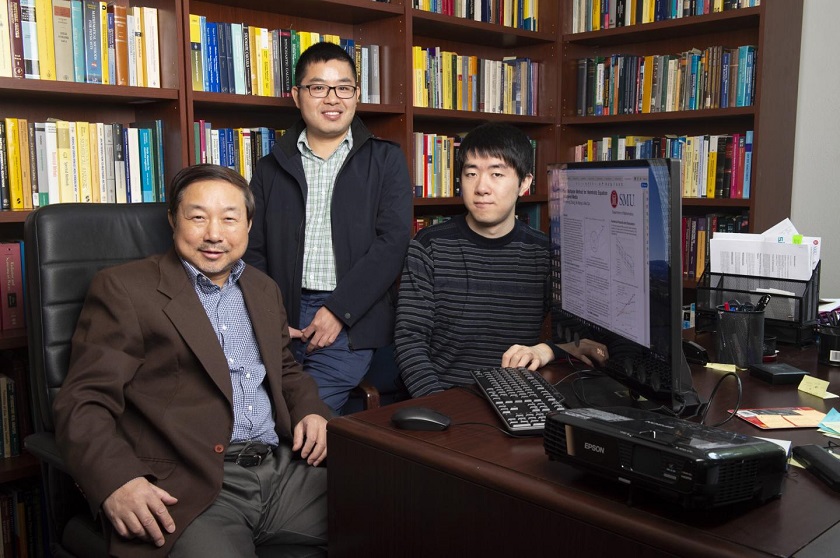 {module INSIDE STORY}
Dr. Bo Wang, a postdoctoral researcher at SMU (Southern Methodist University) and Wenzhong Zhang, a graduate student at the university, also contributed to this research. The study was published today by the SIAM Journal on Scientific Computing.
The algorithm could have significant implications in a number of scientific fields.
"Electromagnetic waves exist as radiation of energies from charges and other quantum processes," Cai explained.
They include things like radio waves, microwaves, light, and X-rays. Electromagnetic waves are also the reason you can use a mobile phone to talk to someone in another state and why you can watch TV. In short, they're everywhere.
An engineer or mathematician would be able to use the algorithm for a device whose job is to pick out a certain electromagnetic wave. For instance, she or he could potentially use it to design a solar light battery that lasts longer and is smaller than currently exists.
"To design a battery that is small in size, you need to optimize the material so that you can get the maximum conversion rate from the light energy to electricity," Cai said. "An engineer could find that maximum conversion rate by going through simulations faster with this algorithm."
Or the algorithm could help an engineering design a seismic monitor to predict earthquakes by tracking elastic waves in the earth, Cai noted.
"These are all waves, and our method applies for different kinds of waves," he said. "There is a wide range of applications with what we have developed."
Supercomputer simulations map out how materials in a device like semiconductor materials will interact with light, in turn giving a sense of what a particular wave will do when it comes in contact with that device.
The manufacturing of many devices involving light interactions uses a fabrication process by layering material on top of each other in a lab, just like Legos. This is called layered media. Computer simulations then analyze the layered media using mathematical models to see how the material in question is interacting with light.
SMU researchers have found a more efficient and less expensive way to solve Helmholtz and Maxwell's equations - difficult to solve but essential tools to predict the behavior of waves.
The problem of the wave source and material interactions in the layer structure has been a very challenging one for the mathematicians and engineers for the last 30 years.
Professor Weng Cho Chew from Electrical and Computer Engineering at Purdue, a world-leading expert on computational electromagnetics, said the problem "is notoriously difficult."
Commenting on the work of Cai and his team, Chew said, "Their results show excellent convergence to small errors. I hope that their results will be widely adopted."
The new algorithm modifies a mathematical method called the fast multipole method, or FMM, which was considered one of the top 10 algorithms in the 20th century.
To test the algorithm, Cai and the other researchers used SMU's ManeFrame II - which is one of the fastest academic supercomputers in the nation - to run many different simulations.
 {module INSIDE STORY}
 {module INSIDE STORY}