

CenturyLink accelerates ongoing Board refreshment process to improve corporate governance

CenturyLink's Glen F. Post, III has decided not to stand for re-election at the Company's 2020 Annual Shareholder Meeting.

"After 34 years of service as a CenturyLink director, I have decided to retire from the Board," Post said. "I leave with a great sense of confidence in Jeff and our leadership team, of pride in our accomplishments together and a real optimism for our future. I am honored to have worked with so many great people to make it so. I will continue to closely follow the Company and I encourage our employees to keep their feet firmly grounded in our Unifying Principles of honesty, integrity, and fairness as they continue to push this great company forward."

"Glen has had a unique and remarkable career," said Jeff Storey, CenturyLink Chief Executive Officer, and President. "He led CenturyLink's transformation into what is today one of the world's leading network services providers. Because of his vision, our future is bright. I have appreciated his support, his counsel and his unfailing focus on doing the right thing. He leaves a legacy of leadership we all strive to emulate." 

In addition to Post's retirement from the Board, current non-executive Board Chairman Harvey Perry will retire effective May 2020 under the Company's director retirement policy. Upon Perry's retirement, T. Michael Glenn will assume the position of Chairman of the Board. Current Vice Chairman Bruce Hanks will continue to serve in that role. {module INSIDE STORY}

Glenn served as a director since Nov. 1, 2017, and is a member of the Audit and Human Resources and Compensation Committees. He served as Senior Advisor at Oak Hill Capital Partners since November 2017. For 35 years until his retirement in December 2016, Glenn served in leadership roles at FedEx Corporation and its predecessor, FedEx Express, including, most recently, as Executive Vice President of Market Development and Corporate Communications for FedEx Corporation. He was also a member of the five-person Executive Committee, responsible for planning and executing the corporation's strategic business activities, and President and Chief Executive Officer of FedEx Corporate Services, responsible for all marketing, sales and retail operations functions for all FedEx Corporation operating companies. Glenn currently serves as a director of Pentair plc and previously served as a director of Level 3 Communications, Inc.

Appointment of Independent Director

The Company also announced today that it has appointed Hal Jones to its Board of Directors, effective Jan. 1, 2020. Jones was recommended to the Board by Southeastern Asset Management. With his election, the Board will comprise 14 members until the 2020 Annual Shareholder Meeting, at which point the Board intends to put forth a slate of 11 directors, 10 of whom will be independent and several of whom will have joined since 2015.

From 2009 to 2013, Jones served as Chief Financial Officer of Graham Holdings Company, a diversified education, and media company, and its predecessor, The Washington Post Company. From 1989 until 2013, he worked in various capacities at The Washington Post Company. From January 2008 to December 2009, he served as the President and Chief Executive Officer of Kaplan Professional, a subsidiary of The Washington Post Company, and in a variety of other capacities from 1989 to 2008. Prior to joining The Washington Post Company, Jones worked for Price Waterhouse (now PricewaterhouseCoopers) from 1977 to 1988. Jones also serves as a director of Playa Hotels and Resorts.

"We are pleased to welcome Hal to the Company's Board," said Storey. "He brings a fresh perspective that will be helpful in the Board's critical role in overseeing the profitable deployment of capital in today's evolving landscape. I am confident that Hal will help us drive success for our shareholders, customers, and employees."

"I am excited to join the Board at this critical time in the Company's evolution," said Jones. "CenturyLink plays an integral role in connecting our world and I look forward to working with management and my fellow Board members to ensure the Company continues to drive long-term value per share."

Enhancements to Corporate Governance Guidelines

In addition to changes in Board Composition, the CenturyLink Board approved the following changes to its Corporate Governance Guidelines:

  • Targeting average Board tenure of no more than 10 years;
  • Targeting to have all non-CEO Board members be independent;
  • Targeting a Board size of between 10 and 12 directors; and
  • Rotating Board committee and Board chairs approximately every five years.

"The CenturyLink Board continuously reviews our governance practices and Board composition to ensure that we are aligned with the interests of all shareholders," said Storey. "We will continue to take actions that we believe will enable us to oversee the execution of a strategy that drives success for our shareholders, customers and employees."
Maxar Technologies sells MDA to Northern Private Capital for CAD$1B

Maxar plans to use the proceeds to pay down debt and fund investments in its core areas of Earth Intelligence and Space Infrastructure

Westminster, CO-based Maxar Technologies has entered into a definitive agreement to sell MDA to a consortium of financial sponsors led by Northern Private Capital (NPC), for CAD$1 billion (US$765 million), subject to customary adjustments. The company expects to use proceeds to reduce leverage and improve its capital structure to prioritize investments for growth in its core areas of Earth Intelligence and Space Infrastructure.

The transaction includes all of MDA’s Canadian businesses, encompassing ground stations, radar satellite products, robotics, defense, and satellite components, representing approximately 1,900 employees. These businesses are expected to generate approximately US$370 million and US$85 million in revenue and Adjusted EBITDA, respectively in 2019. This revenue is inclusive of approximately US$78 million of intercompany sales to other Maxar entities.

Following the completion of the transaction, the MDA team will operate as a stand-alone company within NPC’s portfolio, retaining its name and standing as the leading space and defense company in Canada. MDA expects to continue to supply Maxar with certain components and subsystems, and the companies expect to sell each other’s complementary satellite data. The revenue and Adjusted EBITDA numbers for MDA highlighted above include approximately US$52 million of revenue and US$29 million of Adjusted EBITDA for certain radar related imagery sales which have historically been included in Maxar’s imagery segment. This business activity has been included in the sale of MDA. {module INSIDE STORY}

“The sale of MDA furthers execution on the company’s near-term priority of reducing debt and leverage,” said Dan Jablonsky, Maxar CEO. “It also provides increased flexibility, range, and focus to take advantage of substantial growth opportunities across Earth Intelligence and Space Infrastructure categories. After the transaction is complete, Maxar will retain leading capabilities in geospatial data and analytics, satellites, space robotics, and space infrastructure, and we will continue to have strong alignment with our defense and intelligence customers, the evolving requirements of civil governments, and the pursuit of innovation seen in the commercial marketplace. We thank the talented employees of MDA, who have built a world-class business with unique capabilities, and we look forward to working with them as a commercial partner and component supplier to Maxar going forward.”

“This transaction — when combined with the recently completed sale of real estate in Palo Alto — reduces Maxar’s overall debt by more than $1 billion and significantly reduces Maxar’s leverage ratio,” said Biggs Porter, Maxar CFO. “Also, the loss of future cash flow from MDA will be significantly offset by interest savings from the reduction of debt. We expect the net effect of all these factors to only reduce our prior guidance for Adjusted EBITDA and free cash flow generation in the 2022 to 2023 time period by approximately $50 million.”

Porter continued, “While the sale of MDA will re-baseline the size of the overall company, we continue to expect significant Adjusted EBITDA and Free Cash Flow growth over the next several years as the Legion constellation construction spend completes and the constellation comes online, Services executes on its growing backlog, and Space Infrastructure sees improved profit and cash flow driven by recent re-engineering efforts and new program wins.”

The completion of the transaction is conditioned on regulatory approvals, including review by the Committee on Foreign Investment in the United States, Hart-Scott-Rodino review by the U.S. Department of Justice and the U.S. Federal Trade Commission, and Canadian government reviews under the Radiocommunications Act and the Competition Act.

PJT Partners, RBC Capital Markets, and Bank of America Merrill Lynch are serving as financial advisors to Maxar. Wachtell, Lipton, Rosen & Katz and Stikeman Elliott LLP are serving as the company’s legal advisors for this transaction.

The amounts of revenue and Adjusted EBITDA given above in this release represent the expected results of MDA as they flow into Maxar’s Space Systems and Imagery segments and will vary from the amounts ultimately classified as discontinued operations for MDA, which will reflect interest, depreciation, amortization, taxes, certain corporate expenses, and the effect of blending margins on projects for which MDA is an intercompany subcontractor. The MDA businesses are expected to have approximately US$10 million in Depreciation and Amortization expense.

HKU scientists develop a deep learning approach to predict disease-associated mutations of the metal-binding sites

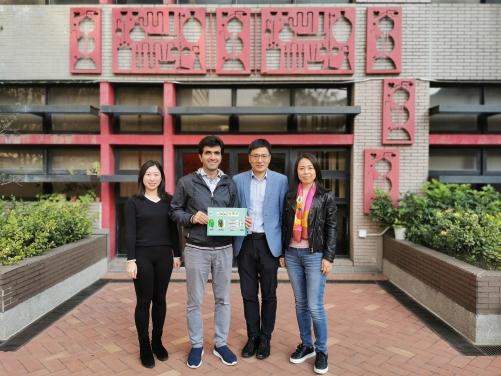
During the past years, artificial intelligence (AI) has become a key player in high-techs like drug development projects. AI tools help scientists to uncover the secret behind the big biological data using optimized computational algorithms. AI methods such as deep neural networks improve decision making in biological and chemical applications i.e., prediction of disease-associated proteins, the discovery of novel biomarkers and de novo design of small molecule drug leads. These state-of-the-art approaches help scientists to develop a potential drug more efficiently and economically. The research team (from left) Dr Haibo Wang, Dr Mohamad Koohi-Moghadam, Professor Hongzhe Sun and Dr Hongyan Li at the Department of Chemistry, HKU

A research team led by Professor Hongzhe Sun from the Department of Chemistry at the University of Hong Kong (HKU), in collaboration with Professor Junwen Wang from Mayo Clinic, Arizona in the United States (a former HKU colleague), implemented a robust deep learning approach to predict disease-associated mutations of the metal-binding sites in a protein. This is the first deep learning approach for the prediction of disease-associated metal-relevant site mutations in metalloproteins, providing a new platform to tackle human diseases. The research findings were recently published in an educational journal. {module INSIDE STORY}

Metal ions play pivotal roles either structurally or functionally in the (patho)physiology of human biological systems. Metals such as zinc, iron, and copper are essential for all lives and their concentration in cells must be strictly regulated. A deficiency or an excess of these physiological metal ions can cause severe disease in humans. It was discovered that a mutation in human genome are strongly associated with different diseases. If these mutations happen in the coding region of DNA, it might disrupt metal-binding sites of the proteins and consequently initiate severe diseases in humans. Understanding of disease-associated mutations at the metal-binding sites of proteins will facilitate the discovery of new drugs.

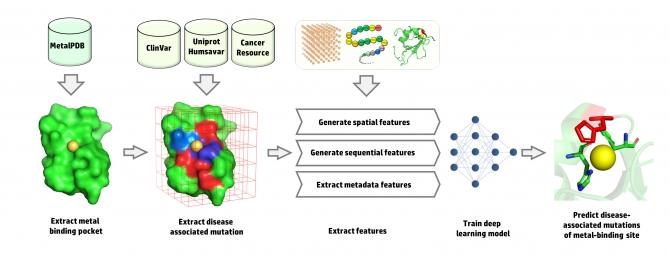
The team first integrated omics data from different databases to build a comprehensive training dataset. By looking at the statistics from the collected data, the team found that different metals have different disease associations. A mutation in zinc-binding sites has a major role in breast, liver, kidney, immune system and prostate diseases. By contrast, the mutations in calcium- and magnesium-binding sites are associated with muscular and immune system diseases, respectively. For iron-binding sites, mutations are more associated with metabolic diseases. Furthermore, mutations of manganese- and copper-binding sites are associated with cardiovascular diseases with the latter being associated with nervous system disease as well. They used a novel approach to extract spatial features from the metal-binding sites using an energy-based affinity grid map. These spatial features have been merged with physicochemical sequential features to train the model. The final results show using the spatial features enhanced the performance of the prediction with an area under the curve (AUC) of 0.90 and an accuracy of 0.82. Given the limited advanced techniques and platforms in the field of metallomics and metalloproteins, the proposed deep learning approach offers a method to integrate the experimental data with bioinformatics analysis. The approach will help scientist to predict DNA mutations which are associated with a disease like cancer, cardiovascular diseases, and genetic disorders. Workflow of data collection and feature extraction to train the deep learning model.{module INSIDE STORY}

Professor Sun said: "Machine learning and AI play important roles in the current biological and chemical science. In my group, we worked on metals in biology and medicine using an integrative omics approach including metallomics and metalloproteomics, and we already produced a large amount of valuable data using in vivo/vitro experiments. We now develop an artificial intelligence approach based on deep learning to turn these raw data into valuable knowledge, leading to uncover secrets behind the diseases and to fight with them. I believe this novel deep learning approach can be used in other projects, which is undergoing in our laboratory."