 Japanese scientists have created a Bose-Einstein condensate out of excitons, quasiparticles that combine electrons and positively charged “holes” in a semiconductor. Quasiparticle Bose-Einstein condensates have for six decades been something of a holy grail of low-temperature physics.
Japanese physicists have created the first Bose-Einstein condensate, the mysterious ”‘fifth state” of matter, made from quasiparticles, entities that do not count as elementary particles but that can still have elementary-particle properties like charge and spin. For decades, it was unknown whether they could undergo Bose-Einstein condensation in the same way as real particles, and it now appears that they can. The finding is set to have a significant impact on the development of quantum technologies including quantum supercomputing. They published a paper describing the process of creation of the substance, achieved at temperatures a hair’s breadth from absolute zero.
Bose-Einstein condensates are sometimes described as the fifth state of matter, alongside solids, liquids, gases, and plasmas. Theoretically predicted in the early 20th century, Bose-Einstein condensates, or BECs, were only created in a lab as recently as 1995. They are also perhaps the oddest state of matter, with a great deal about them remaining unknown to science.
BECs occurs when a group of atoms is cooled to within billionths of a degree above absolute zero. Researchers commonly use lasers and “magnet traps” to steadily reduce the temperature of a gas, typically composed of rubidium atoms. At this ultracool temperature, the atoms barely move and begin to exhibit very strange behavior. They experience the same quantum state — almost like coherent photons in a laser — and start to clump together, occupying the same volume as one indistinguishable “super-atom.” The collection of atoms essentially behaves as a single particle.
Currently, BECs remain the subject of much basic research, and for simulating condensed matter systems, but in principle, they have applications in quantum information processing. Quantum supercomputing, still in the early stages of development, makes use of several different systems. But they all depend upon quantum bits, or qubits, that are in the same quantum state.
Most BECs are fabricated from dilute gases of ordinary atoms. But until now, a BEC made out of exotic atoms has never been achieved.
Exotic atoms are atoms in which one subatomic particle, such as an electron or a proton, is replaced by another subatomic particle that has the same charge. Positronium, for example, is an exotic atom made of an electron and its positively charged anti-particle, a positron.
An “exciton” is another such example. When light hits a semiconductor, the energy is sufficient to “excite” electrons to jump up from the valence level of an atom to its conduction level. These excited electrons then flow freely in an electric current — in essence transforming light energy into electrical energy. When the negatively charged electron performs this jump, the space left behind, or “hole,” can be treated as if it were a positively charged particle. The negative electron and positive hole are attracted and thus bound together.
Combined, this electron-hole pair is an electrically neutral “quasiparticle” called an exciton. A quasiparticle is a particle-like entity that does not count as one of the 17 elementary particles of the standard model of particle physics, but that can still have elementary-particle properties like charge and spin. The exciton quasiparticle can also be described as an exotic atom because it is in effect a hydrogen atom that has had its single positive proton replaced by a single positive hole.
Excitons come in two flavors: orthoexcitons, in which the spin of the electron is parallel to the spin of its hole, and paraexcitons, in which the electron spin is anti-parallel (parallel but in the opposite direction) to that of its hole.
Electron-hole systems have been used to create other phases of matter such as electron-hole plasma and even exciton liquid droplets. The researchers wanted to see if they could make a BEC out of excitons.
“Direct observation of an exciton condensate in a three-dimensional semiconductor has been highly sought after since it was first theoretically proposed in 1962. Nobody knew whether quasiparticles could undergo Bose-Einstein condensation in the same way as real particles,” said Makoto Kuwata-Gonokami, a physicist at the University of Tokyo and co-author of the paper. “It’s kind of the holy grail of low-temperature physics.”
The researchers thought that hydrogen-like paraexcitons created in cuprous oxide (Cu2O), a compound of copper and oxygen, were one of the most promising candidates for fabricating exciton BECs in a bulk semiconductor because of their long lifetime. Attempts at creating paraexciton BEC at liquid helium temperatures of around 2 K had been made in the 1990s, but failed because, to create a BEC out of excitons, temperatures far lower than that are needed. Orthoexcitons cannot reach such a low temperature as they are too short-lived. Paraexcitons, however, are experimentally well known to have an extremely long lifetime of over several hundred nanoseconds, sufficiently long to cool them down to the desired temperature of a BEC.
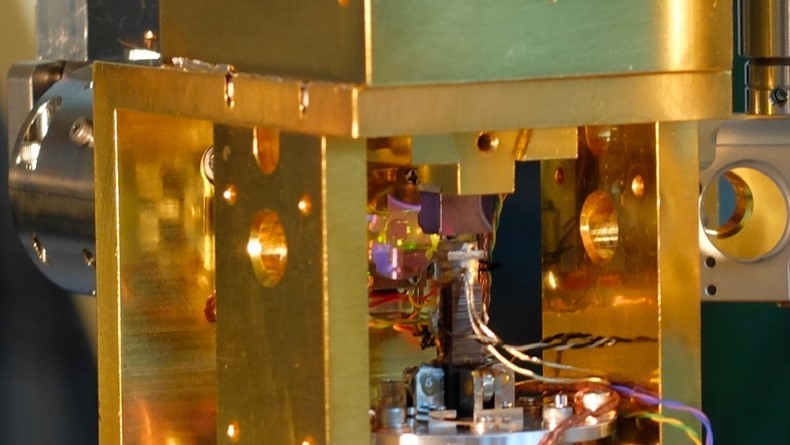
The team managed to trap paraexcitons in the bulk of Cu2O below 400 millikelvins using a dilution refrigerator, a cryogenic device that cools by mixing two isotopes of helium and which is commonly used by scientists attempting to realize quantum supercomputers. They then directly visualized the exciton BEC in real space by the use of mid-infrared induced absorption imaging, a type of microscopy making use of light in the middle of the infrared range. This allowed the team to take precision measurements, including the density and temperature of the excitons, that in turn enabled them to mark out the differences and similarities between exciton BEC and regular atomic BEC.
The group’s next step will be to investigate the dynamics of how the exciton BEC forms in the bulk semiconductor and to investigate collective excitations of exciton BECs. Their ultimate goal is to build a platform based on a system of exciton BECs, for further elucidation of its quantum properties, and to develop a better understanding of the quantum mechanics of qubits that are strongly coupled to their environment.
Funding: This research was supported by MEXT, JSPS KAKENHI (Grant Nos. JP20104002, JP26247049, JP25707024, JP15H06131, JP17H06205); by the Photon Frontier Network Program, Quantum Leap Flagship Program (Q-LEAP) Grant No. JPMXS0118067246 of MEXT; and by JSPS through its FIRST Program.