

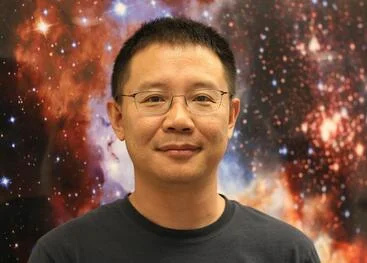
Hai-Bo Yu is a theoretical physicist with expertise in the particle properties of dark matter. (Samantha Tieu)

UC Riverside uses supercomputer simulations to study dark matter; explaining two puzzling issues in astrophysics

A recent study conducted by the University of California, Riverside, proposes a new theory called "self-interacting dark matter" (SIDM) that could solve two astrophysics mysteries related to dark matter. Dark matter makes up about 85% of the universe's matter, but it cannot be seen directly as it is nonluminous. The SIDM theory suggests that dark matter particles interact with each other through a dark force, causing stronger collisions closer to the center of galaxies.

The first mystery involves a high-density dark matter halo observed in a massive elliptical galaxy through gravitational lensing, which conflicts with the prevailing cold dark matter theory. The second puzzle concerns ultra-diffuse galaxies, which have very low-density dark matter halos that are hard to explain using the cold dark matter theory.

To address these mysteries, a research team led by Professor Hai-Bo Yu conducted high-resolution simulations of cosmic structure formation. These simulations showed that dark matter self-interactions result in heat transfer in halos, leading to diversified halo densities in the central regions of galaxies.

The team claims that the SIDM theory offers a compelling explanation for these two astrophysics mysteries, challenging the standard cold dark matter paradigm. They suggest that dark matter may be more complex and active than previously believed. The research also emphasizes the significance of using astrophysical observations and supercomputer simulations to study dark matter.

The study received support from the John Templeton Foundation and the U.S. Department of Energy. The full publication, titled "A Self-interacting Dark Matter Solution to the Extreme Diversity of Low-mass Halo Properties," is available as an open-access document. This research's potential implications are particularly relevant given the anticipated data influx from upcoming astronomical observatories like the James Webb Space Telescope and the Rubin Observatory.

Is it possible that a new law of physics could provide evidence for the idea that our reality is a computer simulation?

Physicist Dr. Melvin Vopson from the University of Portsmouth in the UK has recently discovered a new law of physics, called the Second Law of Infodynamics. This discovery could have significant implications for various scientific disciplines, including genetics, atomic physics, and cosmology.

The Second Law of Infodynamics could support the simulated universe hypothesis, which suggests that the human experience is similar to a computer simulation. Furthermore, it could confirm the Mass-Energy-Information Equivalence Principle, which posits that information is a physical entity that is equivalent to mass and energy. 


This hypothesis is popular among well-known figures like Elon Musk and within the scientific field of information physics, which hypothesizes that physical reality is fundamentally composed of bits of information. In the past, Dr. Vopson has published research indicating that information has mass and that all elementary particles, which are the smallest known building blocks of the universe, contain information about themselves, similar to how humans have DNA.

Dr. Vopson had initially expected that the entropy in information systems would increase over time. However, upon examining the evolution of these systems, he realized that the entropy remains constant or even decreases. This led him to establish the second law of information dynamics, also known as infodynamics. This law could have significant implications for genetics research and evolution theory.

Dr. Vopson, a member of the University’s School of Mathematics and Physics, stated that he realized the far-reaching implications his revelation had across various scientific disciplines. He wanted to put his law to the test to see if it could further support the simulation hypothesis by moving it from the philosophical realm to mainstream science.

The paper presents key findings in three different areas: Biological Systems, Atomic Physics, and Cosmology. 

In Biological Systems, the paper challenges the conventional understanding of genetic mutations, suggesting that they follow a pattern governed by information entropy. This discovery has profound implications for fields such as genetic research, evolutionary biology, genetic therapies, pharmacology, virology, and pandemic monitoring.

In Atomic Physics, the paper explains the behavior of electrons in multi-electron atoms, providing insights into phenomena like Hund's rule. According to the rule, the term with maximum multiplicity lies lowest in energy. Electrons arrange themselves in a way that minimizes their information entropy, shedding light on atomic physics and the stability of chemicals.

In Cosmology, the second law of infodynamics is shown to be a cosmological necessity. This is supported by thermodynamic considerations applied to an adiabatically expanding universe. 

Dr Vopson, the author of the paper, explains that the prevalence of symmetry in the universe is because high symmetry corresponds to the lowest information entropy state. This potentially explains nature's inclination towards symmetry. 

Dr Vopson’s previous research suggests that information is the fundamental building block of the universe and has physical mass. He even claims that information could be the elusive dark matter that makes up almost a third of the universe, which he calls the mass-energy-information equivalence principle.

The paper argues that the second law of infodynamics lends support to this principle, potentially validating the idea that information is a physical entity, equivalent to mass and energy.

“The next steps to complete these studies require empirical testing”, added Dr. Vopson.

“One possible route would be my experiment devised last year to confirm the fifth state of matter in the universe - and change physics as we know it – using particle-antiparticle collisions."

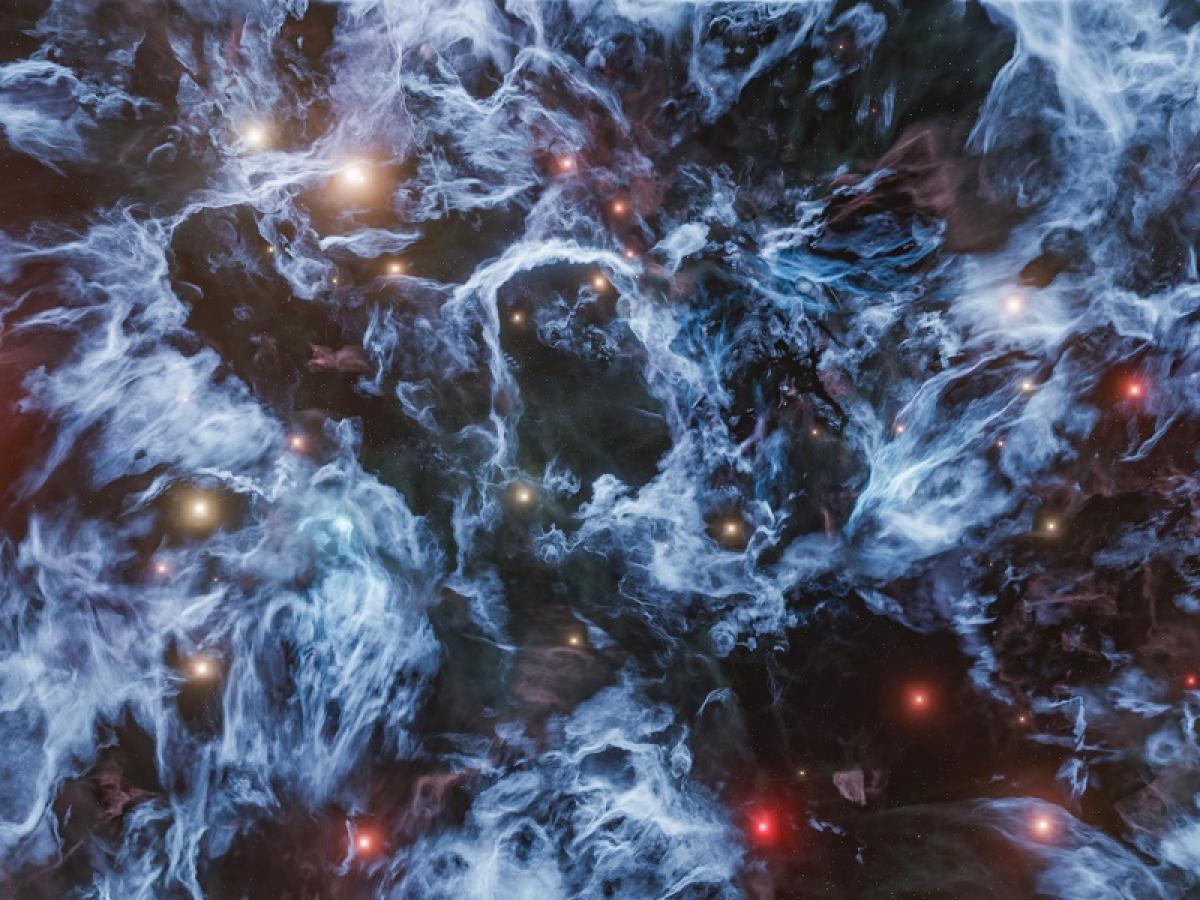
The blue nebula with bright stars background. Credit: Wirestock

Physics Prof Thomas makes a groundbreaking discovery in unlocking the mystery of dark matter

An international team of researchers, led by experts at the University of Adelaide in Australia has made progress in understanding the nature of dark matter.

Dark matter makes up 84% of the matter in the universe and its existence has been confirmed through its gravitational interactions, yet little is known about its precise nature.

The team believes that the key to understanding this mystery could lie with the dark photon, a hypothetical massive particle that could act as a portal between the dark sector of particles and regular matter.

Regular matter, which is what we and our physical world are made up of, is far less abundant than dark matter, with five times more dark matter existing than regular matter.

The team is pursuing different approaches, including testing existing theories about dark matter, to gain more clues into this elusive substance. In their latest study, they examined the potential effects that a dark photon could have on the complete set of experimental results from the deep inelastic scattering process. This process is used to probe the insides of hadrons, such as protons and neutrons, using electrons, muons, and neutrinos.

The team used the state-of-the-art Jefferson Lab Angular Momentum Parton distribution function global analysis framework and modified the underlying theory to allow for the possibility of a dark photon.

“Our work shows that the dark photon hypothesis is preferred over the standard model hypothesis at a significance of 6.5 sigma, which constitutes evidence for a particle discovery," said Professor Anthony Thomas, Elder Professor of Physics, University of Adelaide.

The discovery of new clues to the nature of elusive dark matter by Australian professor Thomas is a breakthrough in our understanding of the universe. This research has the potential to revolutionize our understanding of the universe and open up new possibilities for further exploration. Professor Thomas' work is an inspiring example of the power of scientific inquiry and the importance of never giving up in the pursuit of knowledge. We can only hope that this discovery will lead to further advances in our understanding of the universe and the mysteries of dark matter.