

Chinese researchers investigate escaping atmosphere of hydrogen, helium through simulations

Researchers from the Yunnan Observatories of the Chinese Academy of Sciences and their collaborators reproduced the observed transmission spectra of the exoplanet WASP-52b at different wavelength bands and studied the properties of its hydrogen and helium atmosphere.

Close-in exoplanets receive intense high-energy radiation from their host stars, such as X-rays and extreme ultraviolet (XUV) radiation. In gas-rich exoplanets, the atmosphere may absorb this high-energy radiation, thus heating the atmosphere and causing it to expand to overcome the planet's gravitational potential and escape into the interstellar medium.

This phenomenon is known as planetary atmosphere escape, which can cause the loss of a large amount of material from the planet and has important effects on the composition, evolution, and even the overall distribution of the planet.

The composition and properties of the planetary atmosphere can be studied by analyzing the absorption of spectral lines at different wavelength bands, for example, the optical band (Hα) and near-infrared band (He λ10830Å) lines, the so-called transmission spectra.

In this study, the researchers used the hydrodynamic atmospheric escape model and the radiation transfer model to simulate the transmission spectra of WASP-52b. They introduced the Monte Carlo model to simulate the Lyα resonant scattering inside the exoplanetary atmosphere for the first time, by assuming that both the stellar Lyα radiation and the planetary atmosphere are spherical.

Based on the distribution of the Lyα scattering rate Pα, the researchers calculated the Hα absorption, which is caused by the hydrogen atoms in the first excited states. They also calculated the distribution of metastable helium atoms in detail and simulated the transmission spectra of hot Jupiter WASP-52b in the optical band (Hα) and near-infrared band (He λ10830Å).

They constrained the level of X-rays and extreme ultraviolet radiation received by the planet, as well as the hydrogen to helium abundance ratio in the planetary atmosphere, and revealed that hydrogen and helium originated from the escaping atmosphere. The findings can help to constrain the physical parameters of the atmosphere and to better understand its composition and structure.

Hubble captures a starry scene

hubble terzan4 potw2237a 1 f7a20A glittering multitude of stars in the globular cluster Terzan 4 fills this image from the NASA/ESA Hubble Space Telescope. Globular clusters are collections of stars bound together by their mutual gravitational attraction and can contain millions of individual stars. As this image shows, the heart of a globular cluster such as Terzan 4 is a densely packed, crowded field of stars – which makes for spectacular images!
The launch of Hubble in 1990 revolutionized the study of globular clusters. The individual stars in these dense crowds are almost impossible to distinguish from one another with ground-based telescopes. However, space telescopes can pick them apart. Astronomers took advantage of Hubble’s crystal-clear vision to study the stars that comprise globular clusters, discovering how these systems change over time.

This particular image came from Hubble observations designed to better understand the shape, density, age, and structure of globular clusters close to the center of the Milky Way. Unlike globular clusters elsewhere in the sky, those near the galaxy’s center have evaded detailed observation because of the clouds of gas and dust swirling around our galactic core. These clouds blot out starlight and complicate astronomical observations in a process astronomers refer to as ‘extinction.’

Astronomers took advantage of the sensitivity of two of Hubble’s instruments – the Advanced Camera for Surveys and Wide Field Camera 3 – to overcome the impact of extinction on Terzan 4. By combining Hubble imagery with sophisticated data processing, astronomers were able to determine the ages of galactic globular clusters within a billion years – a relatively accurate measurement in astronomical terms!

Center for Astrophysics' Long develops a new technique to identify small planets hidden in protoplanetary disks

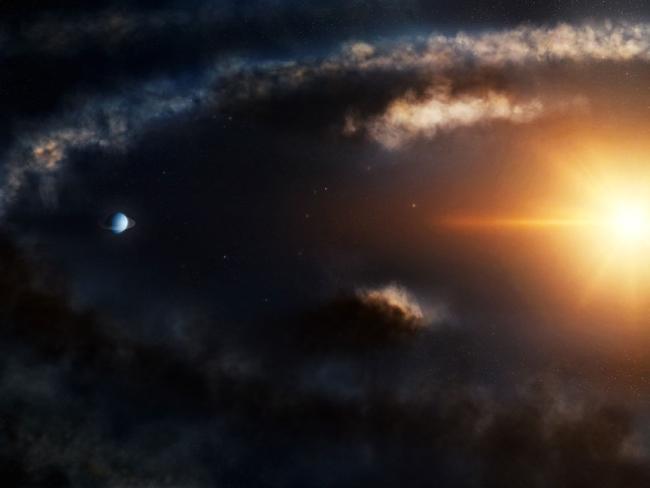
Astronomers agree that planets are born in protoplanetary disks — rings of dust and gas that surround young, newborn stars. While hundreds of these disks have been spotted throughout the universe, observations of actual planetary birth and formation have proved difficult within these environments. Credit: M.Weiss/Center for Astrophysics | Harvard & Smithsonian

Now, astronomers at the Center for Astrophysics | Harvard & Smithsonian have developed a new way to detect these elusive newborn planets — and with it, "smoking gun" evidence of a small Neptune or Saturn-like planet lurking in a disk. The results are described today in The Astrophysical Journal Letters.

"Directly detecting young planets is very challenging and has so far only been successful in one or two cases," says Feng Long, a postdoctoral fellow at the Center for Astrophysics who led the new study. "The planets are always too faint for us to see because they’re embedded in thick layers of gas and dust."

Scientists instead must hunt for clues to infer a planet is developing beneath the dust.

"In the past few years, we've seen many structures pop up on disks that we think are caused by a planet's presence, but it could be caused by something else, too" Long says. "We need new techniques to look at and support that a planet is there."

For her study, Long decided to re-examine a protoplanetary disk known as LkCa 15. Located 518 light years away, the disk sits in the Taurus constellation in the sky. Scientists previously reported evidence for planet formation in the disk using observations with the ALMA Observatory.

Long dove into new high-resolution ALMA data on LkCa 15, obtained primarily in 2019, and discovered two faint features that had not previously been detected.

About 42 astronomical units out from the star — or 42 times the distance Earth is from the Sun — Long discovered a dusty ring with two separate and bright bunches of material orbiting within it. The material took the shape of a small clump and a larger arc and was separated by 120 degrees.

Long examined the scenario with supercomputer models to figure out what was causing the buildup of material and learned that their size and locations matched the model for the presence of a planet.

"This arc and clump are separated by about 120 degrees," she says. "That degree of separation doesn’t just happen — it’s important mathematically."

Long points to positions in space known as Lagrange points, where two bodies in motion — such as a star and orbiting planet — produce enhanced regions of attraction around them where the matter may accumulate.

"We're seeing that this material is not just floating around freely, it's stable and has a preference where it wants to be located based on physics and the objects involved," Long explains.

In this case, the arc and clump of material Long detected are located at the L4 and L5 Lagrange points. Hidden 60 degrees between them is a small planet causing the accumulation of dust at points L4 and L5.

The results show the planet is roughly the size of Neptune or Saturn, and around one to three million years old. (That's relatively young when it comes to planets.)

Directly imaging the small, newborn planet may not be possible any time soon due to technology constraints, but Long believes further ALMA observations of LkCa 15 can provide additional evidence supporting her planetary discovery.

She also hopes her new approach for detecting planets — with material preferentially accumulating at Lagrange points — will be utilized in the future by astronomers.

"I do hope this method can be widely adopted in the future," she says. "The only caveat is that this requires very deep data as the signal is weak."

Long recently completed her postdoctoral fellowship at the Center for Astrophysics and will join the University of Arizona as a NASA Hubble Fellow this September.

This study involved high-resolution ALMA observations taken with Band 6 (1.3mm) and Band 7 (0.88mm) receivers.