

University of Portsmouth uses new physics law to predict genetic mutations

The new study could have big implications for genome research, evolutionary biology, physics, and cosmology. 

Genetic mutations could be predicted before they occur using a new law of physics, according to a study from the University of Portsmouth, England.

The paper finds the second law of information dynamics, or ‘infodynamics’, behaves differently from the second law of thermodynamics - a discovery that could have massive implications for future developments in genome research, evolutionary biology, supercomputing, big data, physics, and cosmology. 

Lead author Dr. Melvin Vopson is from the University’s School of Mathematics and Physics. He said: “In physics, there are laws that govern everything that happens in the universe, for example how objects move, how energy flows, and so on. Everything is based on the laws of physics. 

“One of the most powerful laws is the second law of thermodynamics, which establishes that entropy – a measure of disorder in an isolated system – can only increase or stay the same, but it will never decrease.”

This is an undisputed law linked to the arrow of time, which shows that time only goes one way. It flows in a single direction and can’t go backward.

He said: “Imagine two transparent glass boxes. On the left side, you have red gas molecules, which you can see, like red smoke. On the right side, you have blue smoke, and in between, them is a barrier. If you remove the barrier, the two gases will start mixing and the color will change. There is no process that this system can undergo to separate itself from blue and red again.

“In other words, you cannot lower the entropy or organize the system to how it was before without energy expense, because the entropy only stays constant or increases over time.”

Dr. Vopson is an information physicist. His work explores information systems, which can be anything from the disc in a laptop to the DNA and RNA in living organisms. This paper was written in collaboration with Dr. Serban Lepadatu from the University of Central Lancashire.

Dr. Vopson added: “If the second law of thermodynamics states that entropy needs to stay constant or increase over time, I thought that perhaps information entropy would be the same.

“But what Dr. Lepadatu and I found was the exact opposite – it decreases over time. The second law of information dynamics works exactly in opposition to the second law of thermodynamics.”

Dr. Vopson claims this could be what drives genetic mutations in biological organisms. 

“The worldwide consensus is that mutations take place at random and then natural selection dictates whether the mutation is good or bad for an organism”, he explained. If the mutation is beneficial for an organism, it will be kept. 

“But what if there is a hidden process that drives these mutations? Every time we see something we don’t understand, we describe it as ‘random’ or ‘chaotic’ or ‘paranormal’, but it’s only our inability to explain it. 

“If we can start looking at genetic mutations from a deterministic point of view, we can exploit this new physics law to predict mutations - or the probability of mutations - before they take place.”

Dr. Vopson and colleagues analyzed real Covid-19 (Sars-CoV-2) genomes and found that their information entropy decreased over time: “The best example of something that undergoes a number of mutations in a short space of time is a virus. The pandemic has given us the ideal test sample as Sars-CoV-2 mutated into so many variants and the data available is unbelievable.

“The Covid data confirms the second law of infodynamics and the research opens up unlimited possibilities. Imagine looking at a particular genome and judging whether a mutation is beneficial before it happens. This could be game-changing technology which could be used in genetic therapies, the pharmaceutical industry, evolutionary biology, and pandemic research.”
Identical photons from different sources

Scientists from the University of Basel and the University of Bochum were able to create identical photons simultaneously that originate from different, distant sources.This is an important milestone, as numerous quantum technologies depend on identical photons.

...

Read more

Duke incorporates physics into ML algorithms for new insights into materials

Researchers at Duke University have demonstrated that incorporating known physics into machine learning algorithms can help the inscrutable black boxes attain new levels of transparency and insight into material properties. 

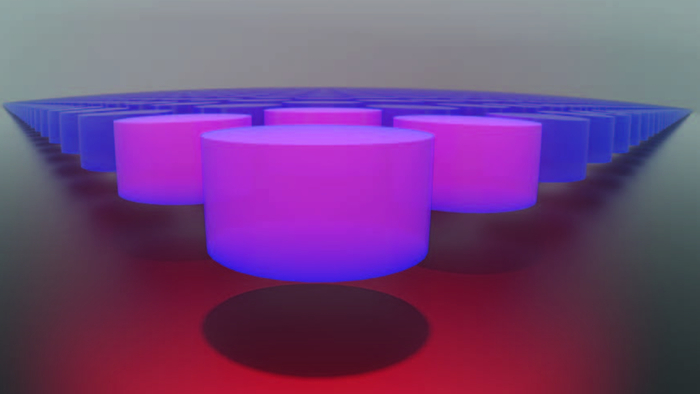
In one of the first projects of its kind, researchers constructed a modern machine learning algorithm to determine the properties of a class of engineered materials known as metamaterials and to predict how they interact with electromagnetic fields. Silicon metamaterials such as this, featuring rows of cylinders extending into the distance, can manipulate light depending on the features of the cylinders. Research has now shown that incorporating known physics into a machine learning algorithm can reveal new insights into how to design them.  CREDIT Omar Khatib

Because it first had to consider the metamaterial’s known physical constraints, the program was essentially forced to show its work. Not only did the approach allow the algorithm to accurately predict the metamaterial’s properties, but it also did so more efficiently than previous methods while providing new insights.

The results appear online the week of May 9 in the journal Advanced Optical Materials.

“By incorporating known physics directly into the machine learning, the algorithm can find solutions with less training data and in less time,” said Willie Padilla, professor of electrical and computer engineering at Duke. “While this study was mainly a demonstration showing that the approach could recreate known solutions, it also revealed some insights into the inner workings of non-metallic metamaterials that nobody knew before.”

Metamaterials are synthetic materials composed of many individual engineered features, which together produce properties not found in nature through their structure rather than their chemistry. In this case, the metamaterial consists of a large grid of silicon cylinders that resemble a Lego baseplate.

Depending on the size and spacing of the cylinders, the metamaterial interacts with electromagnetic waves in various ways, such as absorbing, emitting, or deflecting specific wavelengths. In the new paper, the researchers sought to build a type of machine learning model called a neural network to discover how a range of heights and widths of a single-cylinder affects these interactions. But they also wanted its answers to make sense.

“Neural networks try to find patterns in the data, but sometimes the patterns they find don’t obey the laws of physics, making the model it creates unreliable,” said Jordan Malof, assistant research professor of electrical and computer engineering at Duke. “By forcing the neural network to obey the laws of physics, we prevented it from finding relationships that may fit the data but aren’t actually true.”

The physics that the research team imposed upon the neural network are called a Lorentz model — a set of equations that describe how the intrinsic properties of a material resonate with an electromagnetic field. Rather than jumping straight to predicting a cylinder’s response, the model had to learn to predict the Lorentz parameters that it then used to calculate the cylinder’s response.

Incorporating that extra step, however, is much easier said than done.

“When you make a neural network more interpretable, which is in some sense what we’ve done here, it can be more challenging to fine-tune,” said Omar Khatib, a postdoctoral researcher working in Padilla’s laboratory. “We definitely had a difficult time optimizing the training to learn the patterns.”

Once the model was working, however, it proved to be more efficient than previous neural networks the group had created for the same tasks. In particular, the group found this approach can dramatically reduce the number of parameters needed for the model to determine the metamaterial properties.

They also found that this physics-based approach is capable of making discoveries all on its own.

As an electromagnetic wave travels through an object, it doesn’t necessarily interact with it in the same way at the beginning of its journey as it does at its end. This phenomenon is known as spatial dispersion. Because the researchers had to tweak the spatial dispersion parameters to get the model to work accurately, they discovered insights into the physics of the process that they hadn’t previously known.

“Now that we’ve demonstrated that this can be done, we want to apply this approach to systems where the physics is unknown,” Padilla said.

“Lots of people are using neural networks to predict material properties, but getting enough training data from simulations is a giant pain,” Malof added. “This work also shows a path toward creating models that don’t need as much data, which is useful across the board.”