NASA/Chris Gunn
NASA/Chris Gunn

High-gain antenna for Roman mission clears environmental tests to downlink the highest data volume of any NASA astrophysics mission

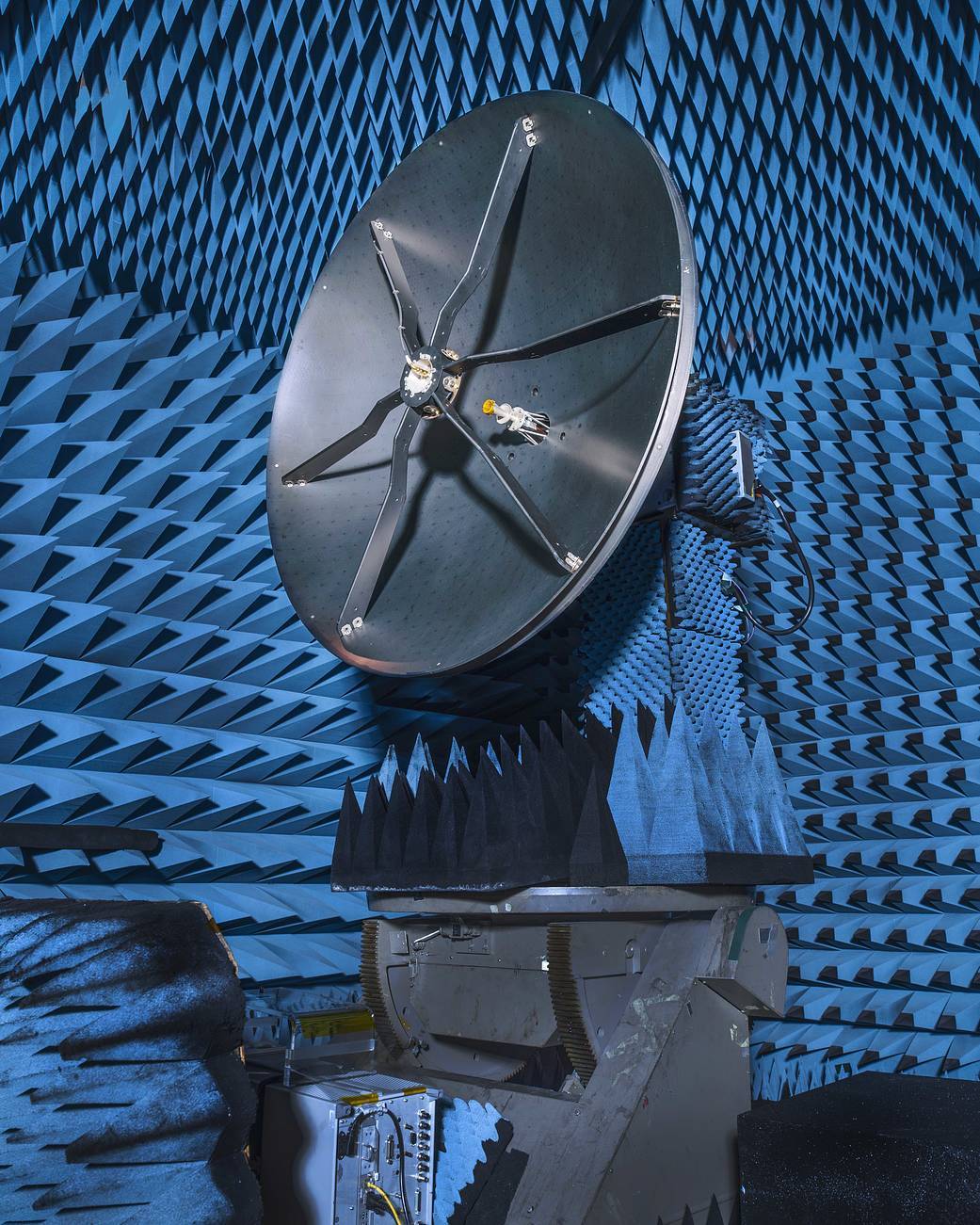
Engineers at NASA's Goddard Space Flight Center in Greenbelt, Maryland, have finished testing the high-gain antenna for the Nancy Grace Roman Space Telescope. When it launches by May 2027, this NASA observatory will help unravel the secrets of dark energy and dark matter, search for and image exoplanets, and explore many topics in infrared astrophysics. Pictured above in a test chamber, the antenna will provide the primary communication link between the Roman spacecraft and the ground. It will downlink the highest data volume of any NASA astrophysics mission so far.

The antenna reflector is made of a carbon composite material that weighs very little but will still withstand the spacecraft’s wide temperature fluctuations. The dish spans 5.6 feet (1.7 meters) in diameter, standing about as tall as a refrigerator, yet only weighs 24 pounds (10.9 kilograms). Its large size will help Roman send radio signals across a million miles of intervening space to Earth. At one frequency, the dual-band antenna will receive commands and send back information about the spacecraft’s health and location. It will use another frequency to transmit a deluge of data at up to 500 megabits per second to ground stations in New Mexico, Australia, and Japan. These locations are spread out so the Roman team will consistently be able to communicate with the spacecraft.

Producing this antenna was a coordinated effort between the government and the commercial sector. NASA was responsible for the radio frequency design and fabrication of the feed assemblies. A commercial partner, Applied Aerospace Structures Corporation (AASC) in Stockton, California, was contracted for the final flight mechanical design and fabrication of the composite reflector and strut assembly. The completed antenna was delivered to NASA in December. Engineers at AASC and Goddard have extensively tested it to confirm it will operate as expected in the extreme environment of space, where it will experience a temperature range of minus 26 to 284 degrees Fahrenheit (minus 32 to 140 degrees Celsius). The team also put the antenna through vibrational testing to make sure it will withstand the spacecraft’s launch. Engineers measured the antenna’s performance in a radio-frequency anechoic test chamber, shown in the photo above. Every surface in the test chamber is covered in pyramidal foam pieces that minimize interfering reflections during testing. Next, the team will attach the antenna to the articulating boom assembly, and then electrically integrate it with Roman’s Radio Frequency Communications System.

Photo Credit: ConceptCafe/Getty Imges

NYU modeling shows the key role of physics in the organization, functionality of the genome

A team of scientists has uncovered the physical principles, a series of forces, and hydrodynamic flows, that help ensure the proper functioning of life’s blueprint. Its discovery provides insights into the genome while potentially offering a new means to spot genomic aberrations linked to developmental disorders and human diseases.

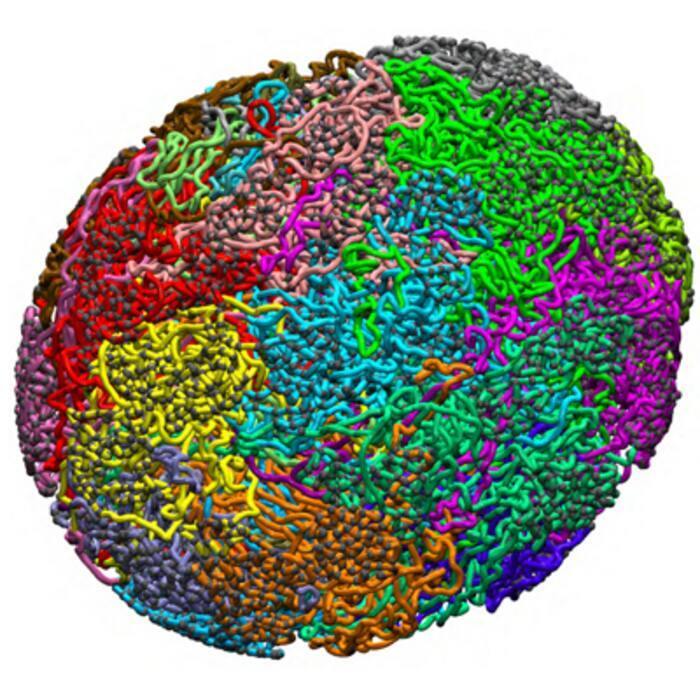
“The way in which the genome is organized and packed inside the nucleus directly affects its biological function, yet the physical principles behind this organization are far from understood,” explains Alexandra Zidovska, an associate professor in New York University’s Department of Physics and an author of the paper, which appears in the journal Physical Review X (PRX). “Our results provide fundamental insights into the biophysical origins of the organization of the genome inside the cell nucleus.”  The cell nucleus is filled with chromosomes, which are illustrated by different colors in this depiction. Its chromosome arrangements are affected by active forces on the genome and their hydrodynamic interactions.  CREDIT Image by Achal Mahajan, UC San Diego

“Such knowledge is crucial for understanding the genome’s function,” adds David Saintillan, a University of California San Diego’s Department of Mechanical and Aerospace Engineering professor and author of the paper.

“Our findings show the key role of physics in the genome’s organization and hence its function,” observes Michael Shelley, a professor at NYU’s Courant Institute of Mathematical Sciences, a researcher at the Flatiron Institute, and an author of the paper.

The team, which also included Wen Yan, formerly of the Flatiron Institute’s Center for Computational Biology, and Achal Mahajan, a UC San Diego doctoral student at the time of the work, focused on the role of the nucleoplasm, the fluid in which the genome is immersed, and the forces that drive its organization.

Specifically, the scientists examined the forces applied on chromosomal material, or chromatin, by enzymes at work in a cell’s nucleus. Here, these forces initiate processes, such as transcription, and act in ways that affect the spatial arrangement of the chromatin. 

This organization affects biological function. But despite the crucial role of this process in conveying genetic information, the physics underlying it is opaque.

In pursuing a greater understanding of this dynamic, the scientists focused on the genome’s compartmentalization into its primary parts, euchromatin, and heterochromatin. Euchromatin contains predominantly actively transcribing genes, which drive expression; heterochromatin includes genes that are silenced—and therefore not expressed in the cell.

To capture this, they created a supercomputer modeling system that replicated this process through a series of simulations. In their model nucleus, 23 chromatin fibers, the number of chromosomes in the human genome, were modeled as floppy chains and stuffed into a fluid-filled sphere. Each chain was divided up into active regions, or euchromatin, and passive heterochromatic regions. 

{media id=294,layout=solo}

They found that when active forces act on the chromatin fiber, they generate flows in the fluid around them, which in turn affect the motion and positioning of the surrounding chromatin. These forces push on the euchromatic parts and drive flows that cause a major spatial rearrangement of the genome, notably leading to the formation of heterochromatin compartments.

“The euchromatic, or active, parts push the heterochromatic, or inactive, parts out of their way and bunch them together,” explains Zidovska. “This is how the cell effectively stores inactive genes.

“This is crucial for our health—if this process goes awry, the organism doesn’t form properly and potentially leads to developmental disorders and other afflictions, such as the development of cancer cells.”

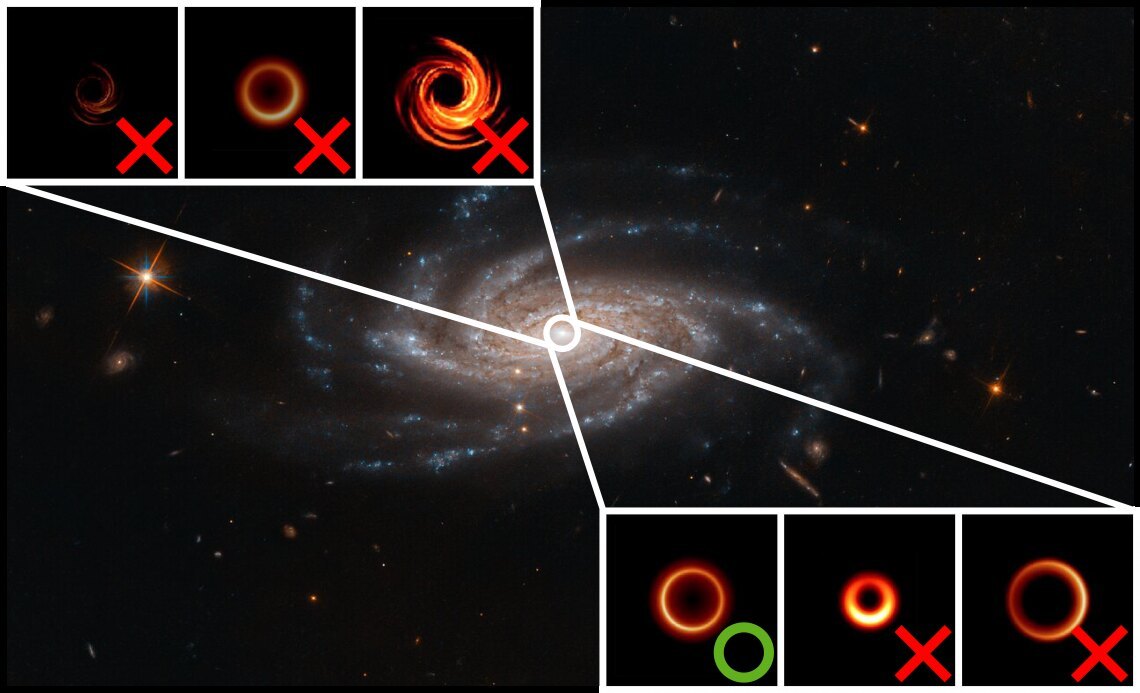
How it works: Using trial and error, machine learning tests many different pairings of simulated galaxies and black holes created using different rules, and then chooses the pairing that best matches actual astronomical observations.H. Zhang, Wielgus et al. (2020), ESA/Hubble & NASA, A. Bellini

Supercomputing shows how black holes grow

Leveraging supercomputing power, University of Arizona researchers created simulations of millions of computer-generated "universes" to test astrophysical predictions that have eluded astronomical observations.

As different as they may seem, black holes and Las Vegas have one thing in common: What happens there stays there – much to the frustration of astrophysicists trying to understand how, when and why black holes form and grow. Black holes are surrounded by a mysterious, invisible layer – the event horizon – from which nothing can escape, be it matter, light or information. The event horizon swallows every bit of evidence about the black hole's past.

"Because of these physical facts, it had been thought impossible to measure how black holes formed," said Peter Behroozi, an associate professor at the University of Arizona Steward Observatory and a project researcher at the National Astronomical Observatory of Japan.

Together with Haowen Zhang, a doctoral student at Steward, Behroozi led an international team to use machine learning and supercomputers to reconstruct the growth histories of black holes, effectively peeling back their event horizons to reveal what lies beyond.

Simulations of millions of computer-generated "universes" revealed that supermassive black holes grow in lockstep with their host galaxies. This had been suspected for 20 years, but scientists had not been able to confirm this relationship until now.

"If you go back to earlier and earlier times in the universe, you find that exactly the same relationship was present," said Behroozi, a co-author on the paper. "So, as the galaxy grows from small to large, its black hole, too, is growing from small to large, in exactly the same way as we see in galaxies today all across the universe."

Most, if not all, galaxies scattered throughout the cosmos are thought to harbor a supermassive black hole at their center. These black holes pack masses greater than 100,000 times that of the sun, with some boasting millions, even billions of solar masses. One of astrophysics' most vexing questions has been how these behemoths grow as fast as they do, and how they form in the first place.

To find answers, Zhang, Behroozi, and their colleagues created Trinity, a platform that uses a novel form of machine learning capable of generating millions of different universes on a supercomputer, each of which obeys different physical theories for how galaxies should form. The researchers built a framework in which computers propose new rules for how supermassive black holes grow over time. They then used those rules to simulate the growth of billions of black holes in a virtual universe and "observed" the virtual universe to test whether it agreed with decades of actual observations of black holes across the real universe. After millions of proposed and rejected rule sets, the computers settled on rules that best described existing observations.

"We're trying to understand the rules of how galaxies form," Behroozi said. "In a nutshell, we make Trinity guess what the physical laws may be and let them go into a simulated universe and see how that universe turns out. Does it look anything like the real one or not?"

According to the researchers, this approach works equally well for anything else inside of the universe, not just galaxies.

The project's name, Trinity, is in reference to its three main areas of study: galaxies, their supermassive black holes, and their dark matter halos – vast cocoons of dark matter that are invisible to direct measurements but whose existence is necessary to explain the physical characteristics of galaxies everywhere. In previous studies, the researchers used an earlier version of their framework, called the UniverseMachine, to simulate millions of galaxies and their dark matter halos. The team discovered that galaxies growing in their dark matter halos follow a precise relationship between the mass of the halo and the mass of the galaxy.

"In our new work, we added black holes to this relationship," Behroozi said, "and then asked how black holes could grow in those galaxies to reproduce all the observations people have made about them."

"We have very good observations of black hole masses," said Zhang, the paper's lead author. "However, those are largely restricted to the local universe. As you look farther away, it becomes increasingly difficult, and eventually impossible, to accurately measure the relationships between the masses of black holes and their host galaxies. Because of that uncertainty, observations can't directly tell us whether that relationship holds up throughout the universe."

Trinity allows astrophysicists to sidestep that limitation and the event horizon information barrier for individual black holes by stitching together information from millions of observed black holes at different stages of their growth. Even though no individual black hole's history could be reconstructed, the researchers could measure the average growth history of all black holes taken together.

"If you put black holes into the simulated galaxies and enter rules about how they grow, you can compare the resulting universe to all the observations of actual black holes that we have," Zhang said. "We can then reconstruct how any black hole and galaxy in the universe looked from today back to the very beginning of the cosmos."

The simulations shed light on another puzzling phenomenon: Supermassive black holes – like the one found in the center of the Milky Way – grew most vigorously during their infancy, when the universe was only a few billion years old, only to slow down dramatically the ensuing time, over the last 10 billion years or so.

"We've known for a while that galaxies have this strange behavior, where they reach a peak in their rate of forming new stars, then it dwindles over time, and then, later on, they stop forming stars altogether," Behroozi said. "Now, we've been able to show that black holes do the same: growing and shutting off at the same times as their host galaxies. This confirms a decades-old hypothesis about black hole growth in galaxies."

However, the result poses more questions, he added. Black holes are much smaller than the galaxies in which they live. If the Milky Way were scaled down to the size of Earth, its supermassive black hole would be the size of the period at the end of this sentence.

For the black hole to double in mass within the same timeframe as the more giant galaxy requires synchronization between gas flows at vastly different scales. How black holes conspire with galaxies to achieve this balance is yet to be understood.

"I think the really original thing about Trinity is that it provides us with a way to find out what kind of connections between black holes and galaxies are consistent with a wide variety of different datasets and observational methods," Zhang said. "The algorithm allows us to pick out precisely those relationships between dark matter halos, galaxies, and black holes that are able to reproduce all the observations that have been made. It basically tells us, 'OK, given all these data, we know the connection between galaxies and black holes must look like this, rather than like that.' And that approach is extremely powerful."