

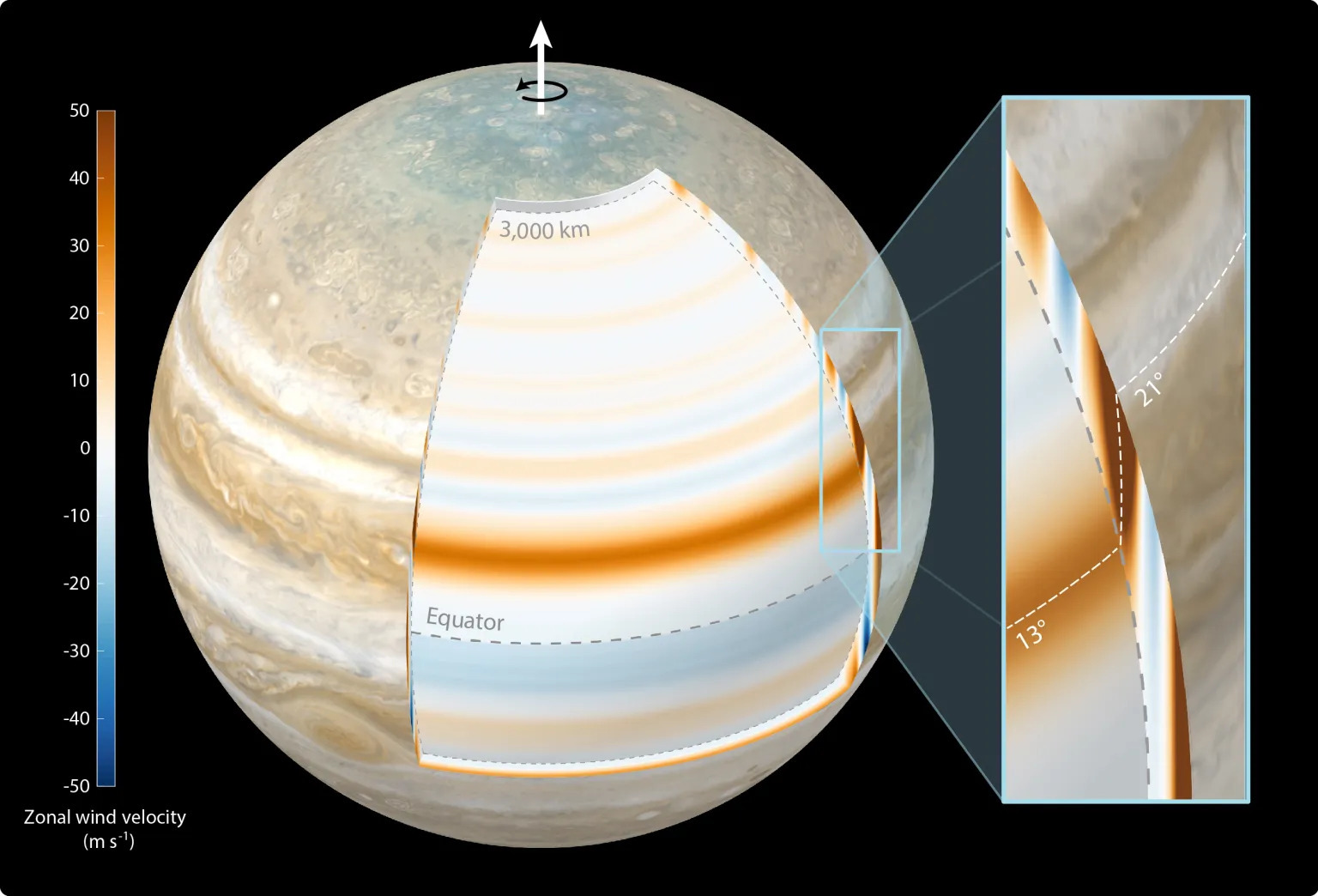
NASA's Juno mission has discovered that the atmospheric winds on Jupiter penetrate the planet in a cylindrical manner and parallel to its spin axis. The most prominent jet observed by Juno is located at 21 degrees north latitude at cloud level, but it shifts to 13 degrees north latitude at a depth of 1,800 miles (3,000 kilometers) below the clouds.

Juno Mission finds Jupiter's winds in cylindrical layers, revealing internal structure

NASA's Juno mission has made a groundbreaking discovery about Jupiter's internal structure. By studying the planet's atmosphere, scientists have found that the atmospheric winds of Jupiter operate in a cylindrical manner parallel to its spin axis. This discovery provides deeper insights into the gas giant's long-debated internal structure.

Juno, the spacecraft that entered Jupiter's orbit in 2016, has been closely observing Jupiter's atmosphere. Its scientific instruments have delved beneath Jupiter's turbulent cloud deck during its 55 flybys. The mission aims to unravel the mysteries of Jupiter's internal workings.

One of the key ways the Juno mission investigates the planet's interior is through radio science. Scientists track Juno's radio signal as it passes by Jupiter at incredible speeds, using the Deep Space Network antennas. These measurements allow researchers to detect tiny variations in Juno's velocity, caused by fluctuations in Jupiter's gravity field.

The high-precision data collected by Juno has led to a series of significant discoveries. These include the identification of a dilute core deep within Jupiter and the determination of the depth of the planet's zones and belts. These zones and belts span approximately 1,860 miles (3,000 kilometers) from the cloud tops.

To pinpoint the location and characteristics of Jupiter's winds, scientists used mathematical techniques commonly used to model the gravitational variations and surface elevations of terrestrial planets, such as Earth. By leveraging Juno's precise measurements, researchers achieved a four-fold increase in resolution over previous models, which relied on data obtained by Voyager and Galileo, previous pioneering missions to Jupiter carried out by NASA.

The study revealed that Jupiter's dominant jet streams, known as zonal flows, extend inward cylindrically from the cloud-level white and red zones and belts, rather than radiating in every direction like a sphere. This finding confirms a two-decade-old model while providing valuable insights into the orientation and structure of these powerful east-west zonal flows.

Ryan Park, a Juno scientist and lead of the mission's gravity science investigation at NASA's Jet Propulsion Laboratory in Southern California, expressed excitement about the application of this constraining technique to outer planets. He stated, "This is the first time such a technique has been applied to an outer planet."

The findings represent a major milestone in our understanding of Jupiter's complex dynamics and internal processes. By unraveling the mysteries of its atmospheric winds, Juno continues to transform our knowledge of this gas giant, shedding light on the mechanisms that drive its extreme weather patterns.

While there is still much to learn about Jupiter, these new revelations bring us one step closer to comprehending the inner workings of this awe-inspiring celestial giant. NASA's Juno mission reinforces the agency's commitment to pushing the boundaries of scientific exploration and unlocking the secrets of our solar system's most mysterious and captivating planets.
AI apps map icebergs 10,000 times faster than humans

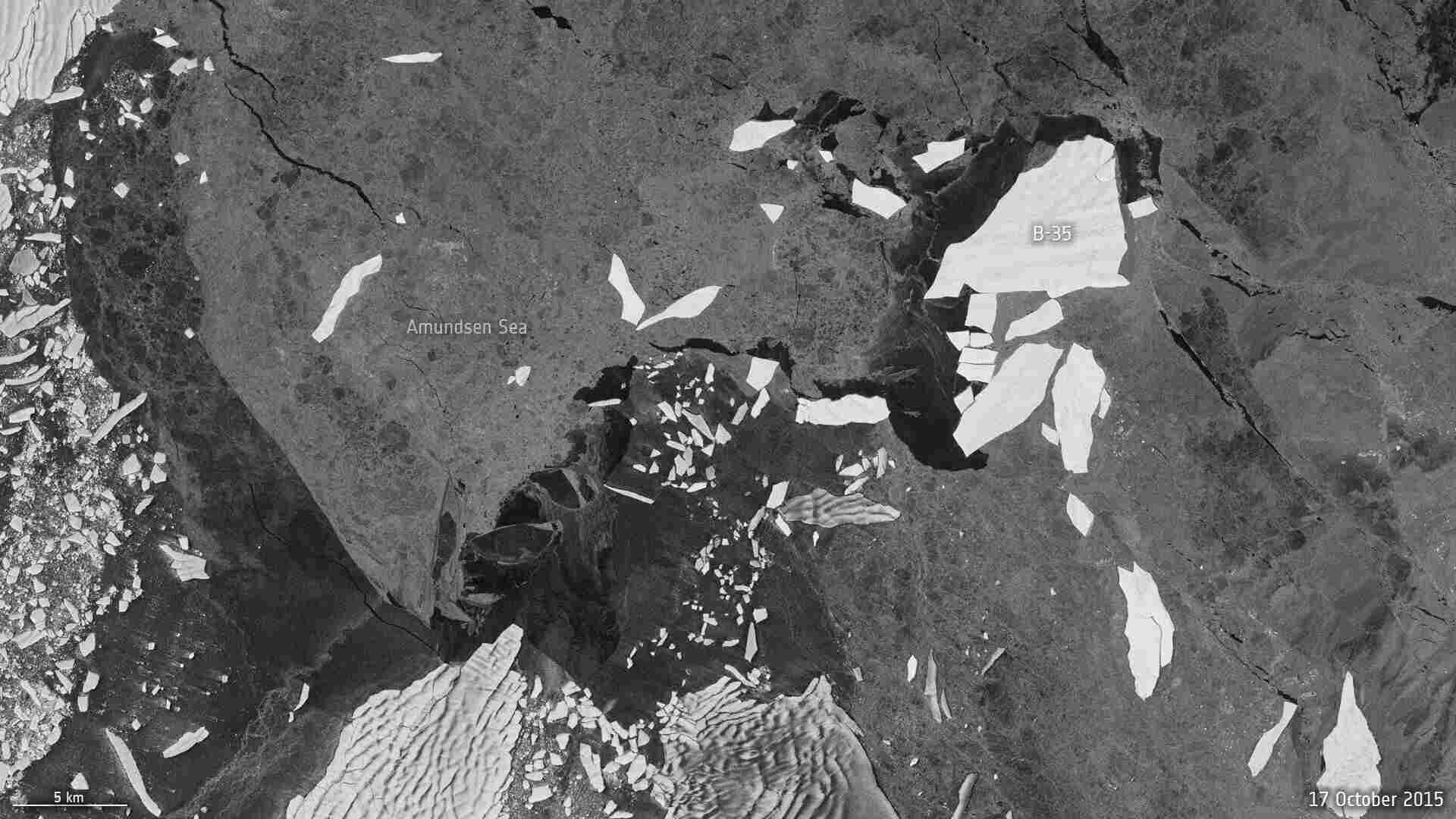
Researchers from the University of Leeds in the UK have developed a neural network that can quickly and accurately map the expanse of large Antarctic icebergs in satellite images. The novel approach takes just 0.01 seconds and is much faster than the laborious manual effort required previously. Anne Braakmann-Folgmann, who researched while she was a Ph.D. student at the University of Leeds and is now an employee at the Arctic University of Norway in Troms, stressed the significance of large icebergs in Antarctica, as they impact ocean physics, chemistry, biology, and maritime operations. Therefore, it is critical to locate icebergs and monitor their extent to quantify how much meltwater they release.

The research team used Artificial Intelligence to map bergs, with the Copernicus Sentinel-1 radar mission providing images of icebergs regardless of cloud cover and lack of daylight. Icebergs, sea ice, and clouds appear white in images taken from satellites, making it difficult to identify them. However, Sentinel-1's radar vision allows icebergs to appear as bright objects against the darker ocean and sea-ice background in most radar images.

Despite the challenging conditions, the new neural network approach excels at mapping iceberg extent, as it takes into account the whole image context as well as intricate non-linear relationships. The system is highly capable of identifying the largest iceberg in each image, unlike comparative methods, which often choose slightly smaller icebergs nearby.

The neural network was trained using U-net architecture, with seven icebergs tested, ranging in size from 54 to 1052 square kilometers. The dataset includes between 15 and 46 images for each iceberg, spanning various seasons and the years 2014-2020. The new system has an accuracy rate of 99%, making it an effective tool for monitoring changes in the vulnerable Antarctic region.

According to ESA's Mark Drinkwater, satellites are crucial for understanding processes occurring far from civilization and monitoring changes. By automating the process of locating and reporting the extent of icebergs, this new neural network saves time and energy. Congratulations to the team on the introduction of this innovative machine-learning approach to monitor changes in the vulnerable Antarctic region.

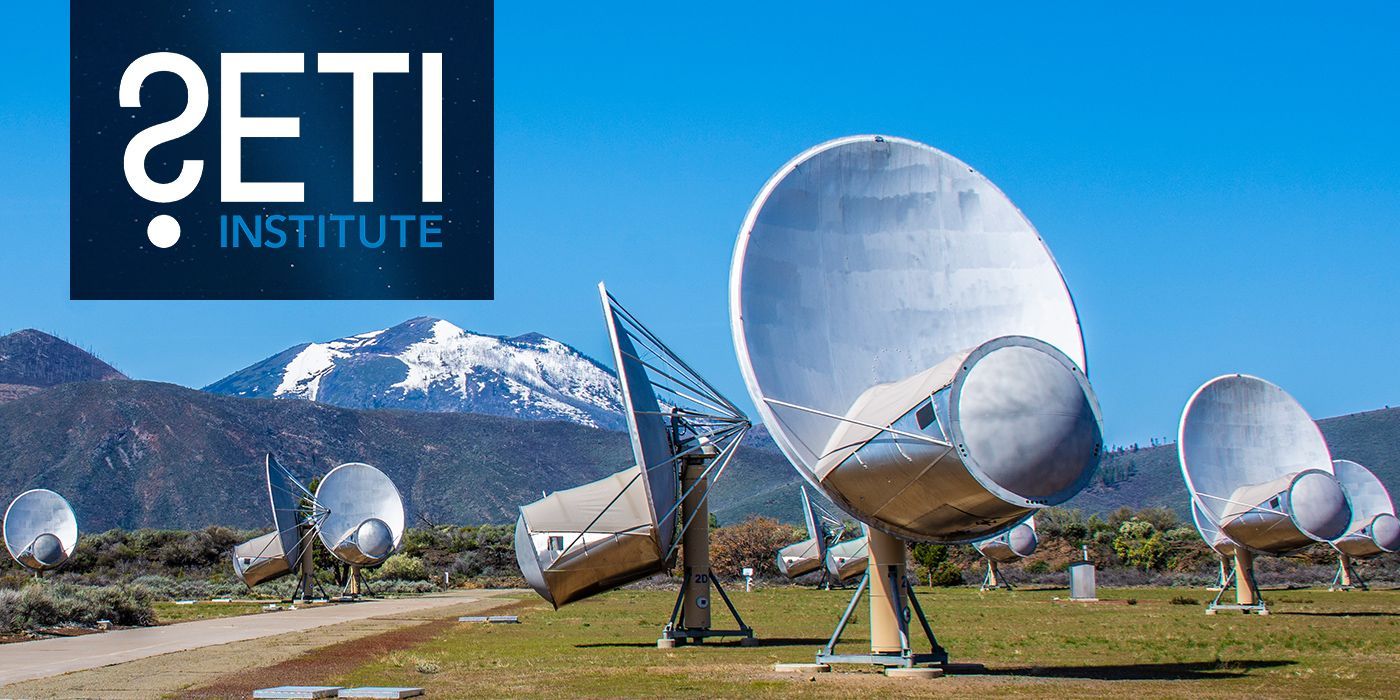
The Allen Telescope Array. Image credit: Simon Steel/SETI Institute

A generous donation of $200 million will help advance the search for life beyond our planet

The SETI Institute, a non-profit scientific research organization, has received a transformative philanthropic gift of $200 million from the estate of Franklin Antonio, who had been a visionary supporter and catalyst of the institute's work for more than 12 years. Franklin Antonio was a co-founder of the communications chip company Qualcomm, and he passed away on May 13, 2022, leaving behind a remarkable legacy to enable breakthrough science in the search for intelligent life beyond our world.

With this generous donation, the SETI Institute will be able to elevate and expedite its research in six key science disciplines: Astronomy and Astrophysics, Exoplanets, Planetary Exploration, Astrobiology, Climate and Bio-geoscience, and the Search for Extraterrestrial Intelligence (SETI). The institute, guided by Antonio's vision, will have the opportunity to make discoveries that will benefit all of humanity for generations to come.

The SETI Institute has more than 100 scientists who are actively conducting research across 173 separate programs. This gift will allow it to undertake more missions, expand research priorities, and push the boundaries of human knowledge in exploring life beyond our planet and the origins of life here on Earth, according to Bill Diamond, President, and CEO of the SETI Institute.

Thanks to this philanthropic gift, the SETI Institute will be able to establish postdoctoral fellowships and internal grants for science and education programs. Additionally, it will expand its research base and extend its reach globally through new international collaborations. The gift will also support the development of innovative observational technologies and analytical instruments, as well as the creation of new educational programs and initiatives, particularly focused on reaching and engaging underserved communities.

Franklin Antonio's contribution to the SETI Institute went beyond financial support. He was an integral part of the technical team and played a crucial role in upgrading the Allen Telescope Array (ATA) to become the world-class radio telescope instrument that it is today, according to Dr. Andrew Siemion, Bernard M. Oliver Chair of SETI Research at the SETI Institute and Director of SETI Research at the University of Oxford.

"Currently, SETI-focused projects are eligible for only limited federal funding through research grants and otherwise depend entirely on philanthropic support and private funding. Antonio's gift will serve to permanently endow core SETI programs and foster new global partnerships," said Dr. Nathalie Cabrol, Director of the Carl Sagan Center for Research at the SETI Institute.

The significant contribution from Franklin Antonio will impact all research domains of the SETI Institute, providing its teams the freedom to pursue their science priorities and examine the technological, philosophical, and societal impact of their research on our daily lives here on Earth. The SETI Institute is a non-profit multi-disciplinary research and education organization founded in 1984, devoted to understanding the origins and prevalence of life and intelligence in the universe. It collaborates closely with industry, academia, and government agencies, including NASA, the Department of Energy, and the National Science Foundation.

Thanks to the philanthropic gift from Franklin Antonio, the SETI Institute is poised to embark on an exciting new chapter in its quest to answer one of the oldest questions in human history: Are we alone in the universe?